By Faith Parum
Key Takeaways
- Per-acre production costs for all nine principal row crops are projected to rise again in 2026, continuing a troubling trend that began after 2021.
- Inflated operating costs remain the primary drivers of higher breakeven prices, with limited relief expected in the near term.
- Recent programs have offset a portion of losses, but do not fully close the gap between costs and market returns, leaving many farmers potentially operating below breakeven for another year.
- Specialty crop growers face similar issues as row crop farmers,but limited data makes per-acre loss estimates challenging.
The USDA-Economic Research Service (ERS) December update to Commodity Costs and Returns provides a comprehensive look at per-acre production costs for the nine principal row crops: corn, soybeans, wheat, cotton, rice, barley, oats, peanuts and sorghum. At a high level, ERS projects average total costs per acre to increase for every crop in 2026, underscoring the persistence of elevated production expenses across U.S. agriculture.
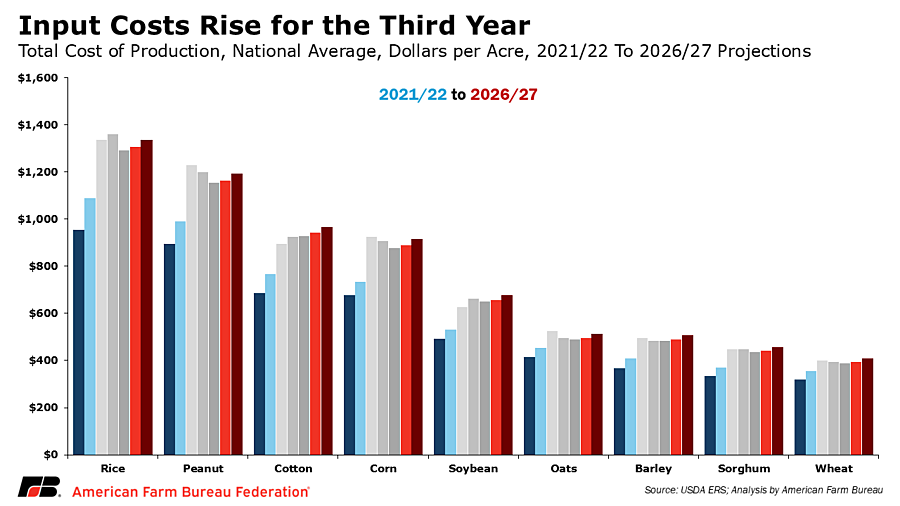
When operating expenses and farm-wide costs like equipment, land and management are combined, costs vary widely by crop. In 2025, forecasted total per-acre costs are $1,308 for rice, $1,166 for peanuts, $943 for cotton, $890 for corn, $658 for soybeans, $498 for oats, $491 for barley, $443 for sorghum, and $396 for wheat. Looking ahead, ERS projections for 2026 suggest continued upward pressure across most cost categories, with total cost increasing anywhere from 2.2% to 3.3%. Amongst the nine principal crops, wheat ($409 per acre), sorghum ($458) and oats ($513) remain at the lower end of the production cost spectrum, while soybeans ($678) and barley ($507) fall in the mid-range in 2026. Cotton ($965), peanuts ($1,194) and rice ($1,336) remain the most expensive crops to produce on a per-acre basis.
Click here to see more...