Farms.com Home   News

Status of Michigan’s Overwintering 2021 Wheat Crop

Status of Michigan’s Overwintering 2021 Wheat Crop

By Dennis Pennington and Ricardo Costa

Earlier this winter, Michigan experienced above-average temperatures and below-normal snowfall. Going into February 2021, most of the state had about one-third of the expected snowfall. Then winter arrived. Snow fell, as did the temperatures. Some locations in the Michigan wheat growing regions reached air temperatures as low as -18 degrees Fahrenheit. So, is this cold enough to kill wheat plants?

Table 1. Minimum crown temperatures and length of time wheat can tolerate before winterkill damage begins to appear.

Temperature (F)

Maximum length (days)

27

150

5

6

-15

0.5

-20

0

Table 1 shows the temperatures that the crown of wheat plants can tolerate. In the overwintering stage, the crown is below the soil surface. This provides some protection from severe cold temperatures. Snow cover provides additional insulation to help protect the crown. Most states have weather networks where soil and air temperature data can be found. In Michigan, we use Michigan State University’s Enviroweather, which allows you to access data from more than 80 weather stations scattered across the state. Data were downloaded and summarized in Figure 1 below. Two-inch soil temperature is a good proxy for crown temperature.
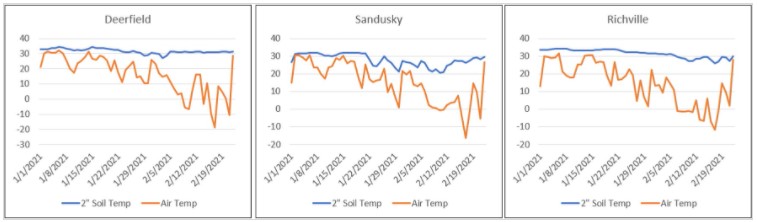
Temperature of different locations

Figure 1. Air and 2-inch soil temperature data at three locations in Michigan from Jan. 1 to Feb. 19, 2021.

Notice that even while air temperatures dipped to near -20 F, the 2-inch soil temperatures did not drop below 20 F. Nearly all the wheat producing areas of the state have had adequate snow cover to protect the crown. The wheat crop is in really good condition at this point. Winter survival should be very high unless the snow melts and we get ponding, icing and extremely cold temperatures.

Source : msu.edu

Trending Video

Seeing the Whole Season: How Continuous Crop Modeling Is Changing Breeding

Video: Seeing the Whole Season: How Continuous Crop Modeling Is Changing Breeding

Plant breeding has long been shaped by snapshots. A walk through a plot. A single set of notes. A yield check at the end of the season. But crops do not grow in moments. They change every day.

In this conversation, Gary Nijak of AerialPLOT explains how continuous crop modeling is changing the way breeders see, measure, and select plants by capturing growth, stress, and recovery across the entire season, not just at isolated points in time.

Nijak breaks down why point-in-time observations can miss critical performance signals, how repeated, season-long data collection removes the human bottleneck in breeding, and what becomes possible when every plot is treated as a living data set. He also explores how continuous modeling allows breeding programs to move beyond vague descriptors and toward measurable, repeatable insights that connect directly to on-farm outcomes.

This conversation explores:

• What continuous crop modeling is and how it works

• Why traditional field observations fall short over a full growing season

• How scale and repeated measurement change breeding decisions

• What “digital twins” of plots mean for selection and performance

• Why data, not hardware, is driving the next shift in breeding innovation As data-driven breeding moves from research into real-world programs, this discussion offers a clear look at how seeing the whole season is reshaping value for breeders, seed companies, and farmers, and why this may be only the beginning.