By Stephanie Porter
As pest pressures continue to shift across the Midwest, Illinois researchers are closely monitoring two insects raising concerns in neighboring states: soybean gall midge and dectes stem borer. Dectes stem borer is an established pest that appears to be growing in importance in Illinois, while soybean gall midge remains a potential invasive species that has not yet reached the state. A multi-year effort funded by the Illinois Soybean Checkoff is helping farmers understand where these pests stand today and what to watch for heading into 2026.
Soybean Gall Midge: Still No Signs in Illinois
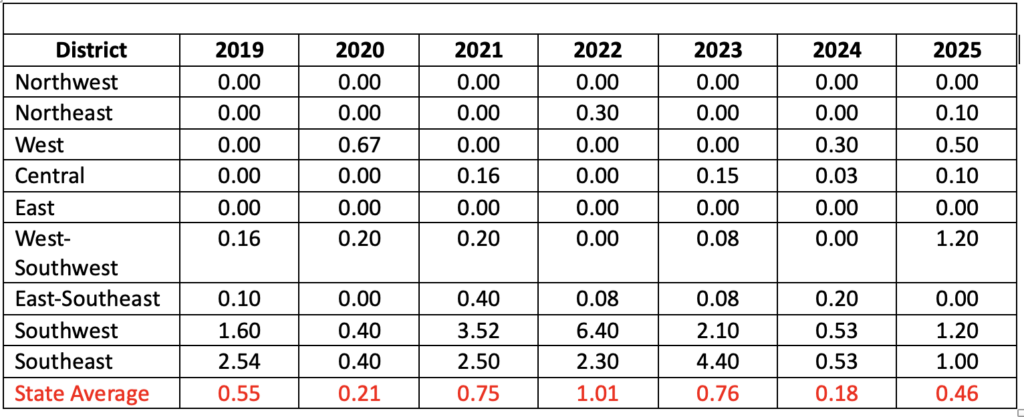
Soybean gall midge has still not been detected in Illinois after three years of statewide monitoring. In 2025, Kelly Estes, University of Illinois Agricultural Pest Survey Coordinator, and her team surveyed 200 soybean fields across 45 counties. Sweep-net samples were collected to monitor adult dectes stem borers and other soybean pests. Because soybean gall midge adults are extremely small and not typically captured in sweep nets, detection efforts rely on examining soybean plants, particularly along field edges where early signs of injury are most likely to appear. To date, no soybean gall midge has been found in Illinois.
Dectes Stem Borer: A Growing, Localized Concern
Meanwhile, Dr. Nick Seiter's lab at the University of Illinois focused on larval populations of dectes stem borer. From 2021 to 2023, they surveyed no-till fields across the state, especially in southern Illinois, to identify where larvae were most prevalent. In 2025, they narrowed their focus to two locations in southern Illinois with known infestations, sampling soybean residue throughout the summer to track the development of overwintered larvae.
Dectes stem borer populations were consistently detected, particularly in south-central Illinois, where no-till and reduced-till soybean production are common. These systems create ideal conditions for the pest because undisturbed crop residue provides excellent overwintering habitat for larvae. Adult borers were first detected in late June (June 25 near Perry and June 26 near Ewing) and remained active through mid-July. This timing is crucial as farmers plan their scouting and management strategies.
Click here to see more...