By Taylor Grussing
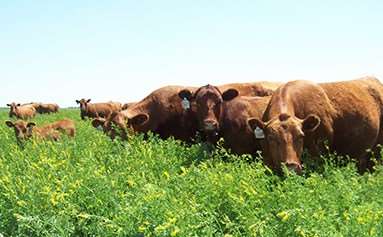
With dry conditions spreading quickly across the Dakota’s, producers are forced to make challenging decisions on how many cow/calf pairs to turn out to pasture, and then determine how long the pastures will even last if moisture doesn’t come soon. During the spring/summer months, supplementing grass with energy and protein can decrease forage dry matter consumption. Supplementing can potentially save some grass and assist producers in maintaining normal cattle numbers even during drought conditions.
Supplement Options
Distillers Grains
Research from Iowa State University showed supplementing dried distillers grains with solubles to heifers on pasture at 1.5% of body weight (BW) on dry matter (DM) basis decreased forage consumption by 26% based on sward height measurements. In addition, supplementing cows with 0.3% - 0.8% of BW/day with a 20 – 28% protein supplement will help meet protein and energy requirements and assist with more efficient forage utilization. Depending on forage supply and time of year, supplement strategies can change. Follow this flow chart to decide when and what type of supplements to use.
Bromegrass
University of Nebraska studied cow/calf pairs on bromegrass when stocked at normal recommendations compared to stocking at twice the rate and supplemented with 30:70 mix of modified distillers grains and ground corn stalks. The supplement was offered at 0.6% of BW (DM basis) initially and increased as forage quality decreased and calves consumed more of the supplement. Results after the grazing season showed similar average daily gain between the treatment groups. Also, pasture conditions after the grazing season was similar between the two treatments based on visual assessment and the amount of forage left. Thus, supplementing cattle grazing cool-season brome pasture with a mixture of concentrate and roughage, replaced grazed forage on a 1:1 basis. (Note: Researchers noted that as byproduct/concentrate inclusion in supplements increased, a negative associate effect on fiber digestion could be seen resulting in decreased forage digestibility. Therefore, consulting a nutritionist or extension specialist to adjust supplement ratios is advised to avoid disrupting fiber digestion and rumen pH.)
Be cautious using this strategy on high-quality native pastures. Making a mistake in stocking density or duration could result in long-term damage to the grazing resource. Overgrazing and/or the added manure nutrients due to supplementation could result in increased proportions of less desirable grass species. Mistakes with a cool-season invasive species such as bromegrass are much less likely to have a long-lasting negative impact.
Purchasing Feed
If supplemental grain, byproducts or harvested forages on the operation are not available, purchases should be made based off of price per pound of energy (TDN) and/or protein (CP). View Feeding at the Right Price for more information.
Click here to see more...