By Emily Cabrera
Over the last few decades, water use-related disagreements between Georgia and its surrounding states have held the spotlight in the Southeast. Legal battles have been fought, and although Georgia won the most recent lawsuit, the court’s decision stressed that Georgia shares the responsibility to conserve that most precious, non-renewable resource on which we all depend — water.
“I work with farmers — it's part of my job — and I can tell you they truly care about stewarding our natural resources,” said Jason Mallard, University of Georgia Cooperative Extension area water agent. “But it’s also my job to support them in learning new production methods as researchers find better, more efficient ways of farming.”
One of those production methods involves integrating advanced technology with traditional irrigation management systems based on research College of Agricultural and Environmental Sciences Associate Professor Wesley Porter has conducted since 2014. As precision agriculture and irrigation specialist for UGA Extension, Porter focuses his research on the optimal water requirements of major row crops grown in Georgia. His research details how overwatering crops can be just as detrimental as underwatering and that hitting the "sweet spot" improves yields. Proper irrigation timing is more critical than the overall amount of water used.
Porter emphasized that “water is the most important agricultural input for successful crop production and large-scale implementation of irrigation scheduling technology is a critical Extension program. Because it’s difficult to progress an agricultural practice through just talks and meetings alone, we have to be able to show the successful implementation of these practices.”
To address that need, the Agricultural Water Efficiency Team (AgWET) was created in 2017 to begin training county Extension agents on advanced irrigation scheduling. Now leading this initiative, Mallard assists agents as they help transfer that knowledge to growers in their counties via a unique one-on-one educational approach.
The advanced irrigation scheduling system involves installing sensors in production fields to track soil moisture content throughout the day, which can be monitored using an app from a smartphone or computer, Mallard explained. A grower can adjust irrigation timing to maximize efficiency based on the crop’s optimal water requirements and the soil moisture content in the field.
Last year, the team deployed three types of soil moisture sensors in 28 production fields across 17 counties in south Georgia.
“County agents worked one-on-one with their growers, on a daily basis at times,” said Mallard. “It was great to be able to do this with the producers and provide real-time troubleshooting and education. I think without that communication method, this project would not have been so successful.”
In its first official year of data collection, the program impacted more than 1,450 acres of row crops in Georgia, 300 acres of peanuts and 1,150 acres of cotton, and yielded an estimated water savings of over 100 million gallons of water.
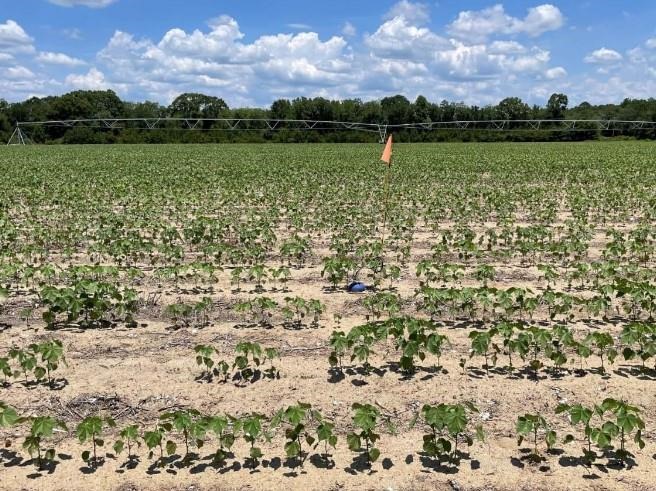
New soil sensors will allow growers to monitor fertilizer movements in their crop rows over time, allowing them to adjust irrigation and other practices to minimize fertilizer loss through leaching.
Mallard hopes the growers from year one are now more aware of the benefits of using advanced irrigation scheduling and feel comfortable using the technology enough to purchase their own sensors.
“There are just so many benefits to using this system, both for the growers in terms of cost savings and yield gains and for our overall effort toward water conservation in Georgia, so we’d love to see this begin to grow across the state,” said Mallard.
Farmers can apply for funding for the technology through various grant programs, such as the National Resources Conservation Service (NRCS) Environmental Quality Incentives Program (EQIP), which helps farmers, ranchers and forest landowners integrate conservation practices into working lands.
The team will begin identifying new producers to participate in the upcoming growing season to expand the knowledge base in hopes of seeing increased adoption rates of the systems across the state.
CAES Associate Dean for Extension Laura Perry Johnson, who has championed the initiative since its inception, said, “it has grown tremendously over the last five years and has resulted in a much better understanding of the process by which farmers make decisions.”
Mallard is excited to expand on the project with newly purchased sensors that can monitor fertilizer movements through salinity levels in the soil at multiple depths simultaneously.
“These new in-soil data insights will allow growers to monitor fertilizer movements in their soil over time and make adjustments in irrigation and other production practices to minimize fertilizer loss through leaching,” Mallard explained.
Source : uga.edu