By Renee Wiatt and Maria Marshall
The survey examined how farmers integrate decisions across three critical areas: farm business planning, production management, and food safety practices. Participants were asked detailed questions about their operational decisions, the timing of various planning activities, and the people involved in farm decision-making processes. The research team sought to understand what decisions farmers make and when and how these decisions occur throughout the production cycle.
This article series will present key findings from the survey, offering insights that can help both growers and Extension educators better understand the interconnected nature of farm planning. These findings aim to support more profitable and sustainable vegetable farming operations by examining the relationship between strategic planning and farm performance.
Succession, Family, and Success: Differences Across Farm Size and Farm Type
While the primary focus of the Soil to Market Producer Survey collected in 2024-2025 was to explore the decision-making of U.S. farm producers with respect to appropriate scale management strategies and practices to enhance economic efficiency and sustainability, it also gathered data on other topics. Some of these topics include farm demographics, business success, farm growth, and farm succession. In this article, we examine the data on succession, success, farm size, and generations of family involved in day-to-day management by farm type (fruits, vegetables, grains, livestock, and row crops) and by farm size (small farm or medium-sized farm).
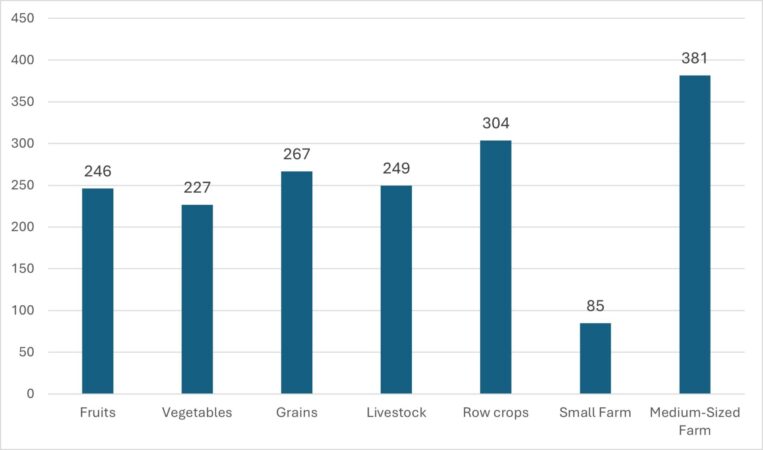
Although all farmers in this survey were vegetable producers, they could also grow other crops such as fruits, grains, livestock, and row crops. Roughly 52.2% of producers indicated that they also produced fruits, 65.4% produced grains, 45.4% produced livestock, and 38.6% produced row crops (such as field corn or soybeans). USDA defines small family farms as those with an annual gross cash flow income (GCFI) of less than $350,000; mid-size farms have a GCFI of $350,000 to $999,999; and large-scale farms are those with a GCFI of $1 million or more (Dorn, 2021). Large-scale farms were excluded from this survey and analysis. Figure 1 reports the average number of acres farmed by farm type and size. Not surprisingly, medium-sized farms reported, on average, farming roughly 381 acres, compared to small farms averaging 85 acres. Row crop farmers have the highest average number of acres farmed, with 304 acres, followed by grain farmers with an average of 267 acres.
Click here to see more...