By Robert Koch
Last year, we discovered a tiny leafmining moth (Macrosaccus morrisella) as a potential new pest of soybean. The larvae of this moth feed inside soybean leaves creating injury called leaf mines. Earlier this year, we posted an article asking people to be on the lookout for this new leaf-mining pest of soybean. We have since received reports of this insect in soybean across a broad area in southern Minnesota. Many of these fields have relatively minor levels of infestation that are not likely to affect soybean yield. However, we received a report of a heavy infestation of this pest on a farm in Sibley County. In one field on this farm, soybean plants on field edges near tree lines were very heavily infested. On one edge, all the plants were infested and the percentage of the leaf area affected with leaf mines ranged from 3% to 42% per plant (average of 14% across the plants on that edge). In contrast, the interior of the field and edges without trees had much lower levels of infestation, with about 1% or less of the leaf area affected with mines.
The images below show the undersides of soybean leaves from this field with injury (mines) from Macrosaccus morrisella.
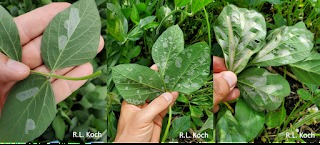
We have been sampling this field intensively throughout the summer to learn more about this pest’s biology and impacts to soybean. We’ll report on these results in future articles and at winter meetings.
The image below shows a close up of the adult moth and a moth placed on a quarter to show how small this insect really is (about the size of Washington's nose).
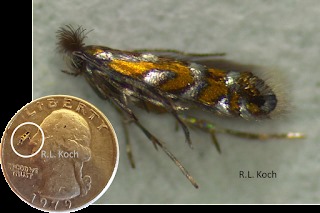
Note: In the previous article, I referred to this insect as the “hog-peanut leafminer,” because one of the native plants that it feeds on is called American hog-peanut. However, an official common name for this insect is under review by the Entomological Society of America and the resulting approved name will likely be different from the one I used earlier.
Source : umn.edu