Farms.com Home  › News

US Hog Inventory Shows Modest Growth Says USDA

US Hog Inventory Shows Modest Growth Says USDA
Jul 01, 2025
By Farms.com

USDA Reports 75 Million Pigs in June

According to the USDA’s National Agricultural Statistics Service (NASS), the number of hogs and pigs on U.S. farms as of June 1, 2025, totaled 75.1 million, showing a slight rise compared to June 2024 and a 1% increase from March 1, 2025. These findings come from the latest Quarterly Hogs and Pigs report, which helps monitor livestock trends and plan farm operations. 
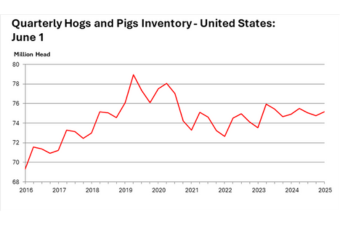
Quarterly Hogs and Pigs Inventory - U.S.A. : June 1

Source: USDA

Out of the total, 69.2 million hogs were classified as market hogs, while 5.98 million were kept for breeding purposes. Between March and May 2025, about 34.2 million pigs were weaned on U.S. farms, which is a 1% increase over the same period in 2024. During this time, farmers averaged 11.75 pigs per litter, reflecting continued improvements in swine productivity. 

Producers are also planning ahead. The report shows that U.S. hog farmers intend to farrow 2.97 million sows between June and August 2025, and another 2.95 million sows between September and November 2025, showing steady reproductive activity across the sector. 

Iowa continues to lead the country in hog inventory, holding 24.7 million head. Minnesota follows with 9.30 million, and North Carolina comes in third with 7.80 million head. 

To gather accurate data for this report, NASS surveyed 4,476 hog operators using online platforms, mail, phone interviews, and in-person visits during the first half of March. 

The Quarterly Hogs and Pigs report is publicly available on the USDA NASS website and serves as a key reference for the livestock industry.

Photo Credit: USDA


Trending Video

What Happens When Pigs Adapt to High Soybean Meal Diets? - Gustavo Lima

Video: What Happens When Pigs Adapt to High Soybean Meal Diets? - Gustavo Lima


In this special rerun episode of The Swine Nutrition Blackbelt Podcast, Gustavo Lima, PhD candidate in Animal Science at Iowa State University, discusses how grow-finish pigs respond to high soybean meal diets. He explains the initial drop in feed intake, changes in backfat, later adaptation, energy efficiency, amino acid utilization, and the rise in nitrogen excretion at higher inclusion levels. Listen now on all major platforms!

Click here to read the full research article: https://academic.oup.com/jas/article/...

“Once they got adapted to the diet, they can handle higher levels of inclusion of soybean meal.”

Meet the guest: Gustavo Lima / gustavo-lima-a9867127 is a PhD candidate in Animal Science at Iowa State University whose work focuses on swine nutrition, ingredient characterization, energy metabolism, caloric efficiency, and applied data analysis. With more than 15 years of experience in swine production across Latin America, Gustavo also brings expertise in environmental control, performance evaluation, barn ventilation, and grow-finish housing. Learn more from Gustavo Lima on The Swine Nutrition Blackbelt Podcast, available on all major platforms.