By Elliott Dennis and Sera Chiuchiarelli et.al
Mexico exported feeder cattle to the US until New World Screwworm (NWS) caused officials to stop this flow in 2025. Given the partial reopening in effect now, there is uncertainty about the level of live trade going forward.
We estimate the impacts on the US and Mexico going from baseline projections where live trade returns to pre-entry levels to an alternative case with less live trade. As expected, the shortfall in US supplies leads to higher feeder cattle, fed cattle, and beef prices, although US producer response moderates these impacts over time. The animals do not vanish but instead lead to greater beef production in Mexico. The beef trade impacts are more net imports into the US and more net exports from Mexico. Overall, the sector loses some efficiency as we see less total production at a higher price.
Live Animal Trade: Recovery or Flat?
The expansion of New World Screwworm (NWS) in Mexico led the USDA to close the border to cattle imports in May 2025 in an effort to curb its potential spread in the US. The US-Mexico border partially reopened in August 2026 and additional ports of entry opened in September 2026. This article compares what could happen to the US and Mexico beef markets under two different paths for live animal trade over the 2027-2031 period. The comparison illustrates how a potential future border closure could affect prices and production in the two countries.
Data and Methods
The FAPRI-MU baseline released in August 2026 assumed that live animal imports from Mexico would recover to historical levels over several years when it was published (available here). The blue line in Figure 1 shows the gradual recovery of feeder cattle imports to over 1.2 million head per year across all border crossing locations. This volume is similar to historical levels but is subject to variation due to market conditions in the projection period.
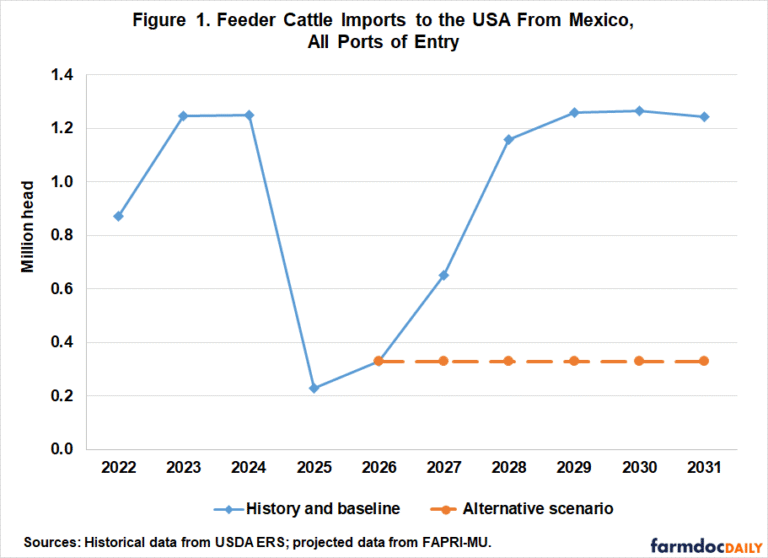
One alternative scenario assumes that feeder cattle imports from Mexico stay flat at their current level or approximately 330 thousand head per year. This could be due to a variety of political or market decisions. Given this assumption, that would cut the number of feeder cattle imports in half for 2027 and reduce the import flow by almost 75% for 2028-2031. We use the FAPRI-MU models of agricultural and related markets to estimate the impacts. The results below focus on US and Mexico beef market conditions, but the model also captures this impact on other markets, such as other livestock products, crop, and renewable fuels. The results below consider the changes from the baseline paths caused by the alternative feeder cattle import scenario and do not reflect year-over-year changes.
Source : illinois.edu