By Henrique Monaco and Carl Zulauf et.al
This article documents increases in premium support associated with two county add-on products: the Supplemental Coverage Option (SCO) and the Enhanced Coverage Option (ECO). Premium support is the amount of premium paid by the Federal government and is typically the largest Federal outlay associated with Federal crop insurance. Together, ECO and SCO accounted for 35% of total premium subsidies in 2026 for the nine major crops, up from 4% in 2024 and 16.7% in 2025. That percentage varies across the country, with higher values in the Midwest. Much of this increase can be associated with increases in premium subsidies in the One Big Beautiful Bill Act (see farmdoc daily, August 26, 2026). This article examines how recent subsidy increases for ECO and SCO have impacted the distribution of federal premium support across crops and regions.
The Adoption Response to Subsidy Increases
SCO and ECO are county-level products that farmers can purchase in addition to more typical farm-level products such as Revenue Protection (RP), Revenue Protection with Harvest Price Exclusion (RP-HPE), Yield Protection (YP), and actual production history (APH). Their adoption has risen due, in large part, to the increase in the percentage of premium paid by the Federal government. The One Big Beautiful Bill Act (OBBBA) increased premium support on SCO and ECO from 65% to 80%, the same subsidy rate as cotton STAX. STAX is a county-level product similar to SCO, which was instituted as a substitute for Title I programs for cotton when Title I programs were eliminated. As a result, SCO and ECO use increased. Because SCO goes down to the coverage level of the underlying farm-level product, some declines in farm-level coverage have occurred.
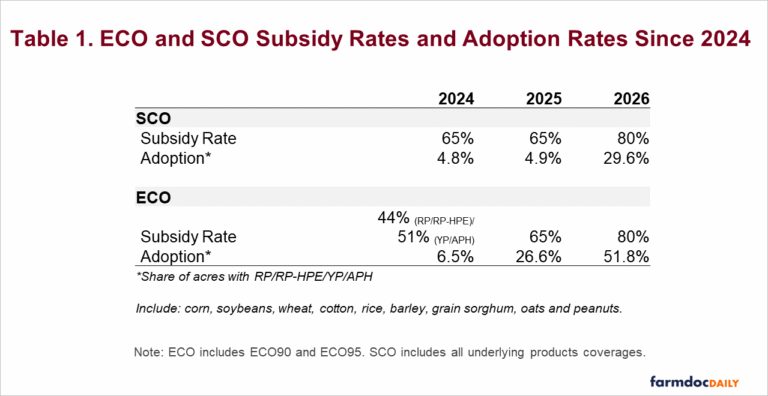
Table 1 summarizes SCO and ECO subsidy rates and adoption rates as a share of eligible acres for the past three years for nine crops that USDA calculates costs of production: Corn, soybeans, wheat, cotton, rice, grain sorghum, peanuts, barley, and oats. Eligible acres represent acres with individual farm-level products on which the county-level add-ons could be purchased. SCO had a 65% subsidy rate in 2024 and 2025, and the adoption rate was 4.8 and 4.9%. OBBBA increased the subsidy rate to 80%, and adoption rates increased to 29.6%. The Risk Management Agency (RMA) also increased the ECO subsidy rate to 65% in 2025, and following OBBBA, to 80% in 2026. Adoption responded significantly increasing from 6.5% in 2024 to 26.6% in 2025 to 51.8% in 2026 (data as of October 20). For a more in-depth discussion of the subsidy increases, see farmdoc daily of December 10, 2025.
Regional adoption of SCO and ECO varied substantially. SCO adoption exceeded 50% in the Texas panhandle, driven by cotton uptake (see Figure 1). By switching to SCO rather than using cotton STAX, cotton producers became eligible for commodity title payments, a change made in the OBBBA. Farmers in the Midwest and Great Plains also increased adoption, with some counties having adoption rates ranging between 30-50%.
Source : illinois.edu