By Susan V. Fisk
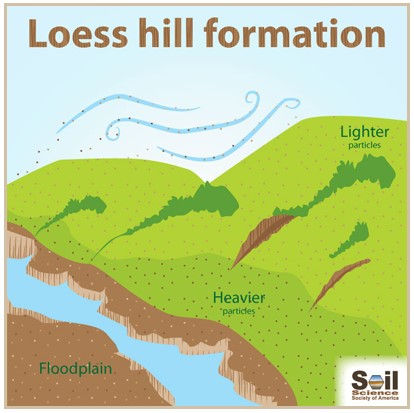
Iowa, known for its farms, also claims fame to a dramatic, rolling landscape known as loess hills. The Soil Science Society of America (SSSA) June 15 Soils Matter blog explains what formed this feature, and why its soil requires special care.
Loess (from the German word “löss,” which translates as “loose”) hills are formed by finely-textured silt that has been carried by the wind. About 10% of the Earth’s surface has this feature—but Iowa’s deposits are particularly deep, and famously productive in agricultural uses.
Blogger Mary Tiedeman, an Iowa-raised soil scientist at Florida International University, explains. “The high silt content of loess-derived soils allows water to drain freely through the profile, ensuring that plant roots receive constant supplies of oxygen and do not become water logged. Water that does stay within the soil is held loosely so plant roots can access it with minimal effort. The texture of silt also enables roots to colonize soil profiles without restriction.”
This loose structure, however, comes with a downfall: erosion. “To use loess soils sustainably, managers must control wind and water erosion,” Tiedeman says. In agriculture, strategies include the use of cover crops, intercropping, terraces, and limited tilling. “The steepest areas may be better left undeveloped, or used as grazing land, recreation, and/or conservation land.”
Click here to see more...