Farms.com recently released a brief questionnaire
By Diego Flammini
Assistant Editor, North American Content
Farms.com
A recent Farms.com article tested farmers on their knowledge when it comes to driving machinery on Ontario roads.
So without any further hesitation, here are the answers to the questions.
1) When operating farm equipment, operators must wear seatbelts.
The answer is false.
Why?
Section 106 of the Highway Traffic Act (HTA) pertains to seat belts and when it comes to vehicle speeds, some seat belt exceptions apply.
“(Seat belts are not required when someone) is actually engaged in work which requires him or her to alight from and re-enter the motor vehicle at frequent intervals and the motor vehicle does not travel at a speed exceeding 40 kilometres per hour,” reads the HTA.
2) While operating farm equipment, drivers can be charged with offences in the HTA including careless driving and failure to signal.
The answer is true.
Why?
According to the Ministry of Transportation’s (MTO) Farm Guide, most rules of the road that apply to regular vehicles also apply to farm equipment. Careless driving and failure to signal are a few examples of these rules.
3) A slow-moving vehicle sign must be visible from at least 200 ft.
The answer is false.
Why?
The MTO’s Farm Guide outlines that a slow-moving vehicle sign must be “clearly visible from a distance not less than 150 m (500 ft.).
4) At night, farm equipment only requires two white or amber headlamps.
The answer is false.
Why?
The Farm Guide states that all farm equipment requires two white or amber headlamps and at least one red tail lamp. Different lighting regulations apply depending if the equipment exceeds certain dimensions.
5) Tractors are allowed to travel on 400 series highways.
The answer is false.
Why?
According to Regulation 609 of the HTA, farm equipment is prohibited from operating on the 400, 401, 402, 403, 404, 405, 406, 407, 409, 410, 417, 420, 427 and QEW highways.
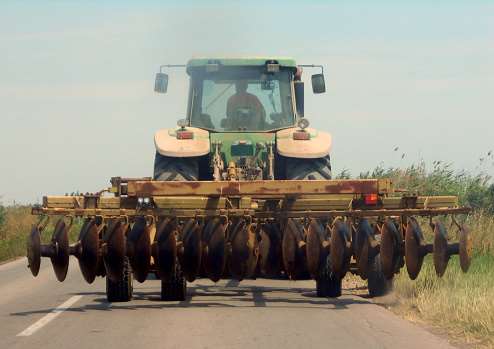
6) Tractors are allowed to travel on 400 series highways if there is no other route to the farm.
The answer is true.
Why?
Regulation 609 of the HTA states that if there’s no other way to access the owner’s farmland, a 400 series highway may be travelled on, provided the shortest route is taken.
7) Farmers may be held responsible if an overweight piece of equipment causes damage to a highway or bridge.
The answer is true.
Why?
Section 84 of HTA states “No person shall drive or operate or permit the driving or operation upon a highway of a vehicle, a street car or vehicles that in combination are in such a dangerous or unsafe condition as to endanger any person.”
These rules also apply to farm equipment and the owners may be held responsible if a highway or bridge is damaged as a result of overweight machinery.
8) A slow-moving vehicle sign warns other drivers the farm machinery is travelling at 40km/h or less.
The answer is true.
Why?
Section 76 of the HTA says farm tractors and other vehicles incapable of attaining and sustaining speeds over 40 km/h must have a slow-moving vehicle sign.
9) An Ontario driver’s license is required to drive a tractor.
The answer is false.
Why?
According to HTA and the MTO’s Farm Guide, a driver’s license is not required to drive a tractor along or across a road. Drivers must be 16 or older to drive on, or along, a road. Drivers under 16 can only drive tractors directly across a road.
10) Farm equipment tires do not require Department of Transportation markings, as is required to trucks and trailers.
The answer is true.
Why?
Sections 69 and 70 of the HTA outline tire requirements. While farm equipment tires don’t require markings, there are certain requirements that need to be met, including being free of any abnormal bumps, bulges or knots.
How many questions did you answer correctly?