Scotiabank V.P. Gampel offers outlook at Precision Ag Conference
By Farms.com Media Team
Analyzing and forecasting the global economy has nothing to do with astronomy. But Aron Gampel uses the reference when he looks ahead at what is to come.
“The stars are aligning in a way that we are not headed into a massive global downturn,” he explained just before delivering a keynote address at the Precision Agriculture Conference Wednesday in London, Ontario.
Gampel is the vice-president and deputy chief economist with Scotiabank Economics and his presentation to commercial farmers and agribusiness professionals came one day after the publication of Scotiabank’s Global Forecast Update.
“The global economy is growing. But it’s growing slowly.”
Gampel, who spoke with Farms.com before his keynote (see photo below), said we live in an imbalanced world at present, with advanced economies “having some challenges coming out of low gear.
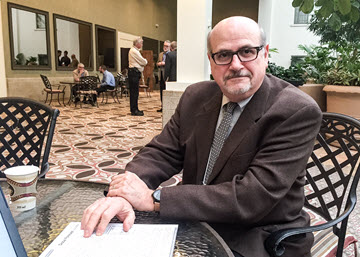
“The U.S. seems to be picking up gradually but areas such as the euro zone and Japan have been unable to achieve meaningful growth.
“At the same time, China and India have slowed. And many emerging economies are tied not only to the U.S. (Latin America for example) but to Asia Pacific, and to China and India in particular.”
Here in Canada, low commodity prices (for energy and mining especially, while less-so for agriculture and forestry) are responsible for a slumping economic performance.
“And the commodity price compression is effectively undermining the growth of the oil and natural-gas producing countries. Around the world, countries had invested to take advantage of high oil prices. Norway, Russia, Canada, the U.S., Mexico, the UK, Vietnam, Columbia.
“Traditionally when oil prices have been low, OPEC (aka Saudi Arabia) has cut production to eventually revive prices. This time they have increased production to lower prices and drive out competitors.”
Gampel further explains the global economic situation at this point in time.
“So we have provinces in or close to recession. And parts of the U.S. – Texas, North Dakota, for example -- also in recession. Because the price declines are now forcing oil producing companies to massively cut back operations through job cuts, production, et cetera.
“In order to rebalance this market, you either need to see more demand (which is likely coming slowly), but to balance faster, you need to see production cutbacks.
“This will come, because the cost of production is higher than sales.”
The Toronto-based Gampel has been with Scotiabank for over 30 years. He explained that “interest rates are not going up. They are at rock bottom levels, and are going to stay very low.
“For those who want to take on debt, conditions will continue to be favourable.”
He also looked ahead to a federal budget coming out of Ottawa next month.
“In Canada we have a more activist new federal government. So beginning later in March we should expect a budget that will boost the deficit to provide a short and medium-term stimulus to the economy.
“Expect the pedal to the metal at that time.”
Other projections from the Scotiabank Update (which can be found here) include:
• We have cut our forecast for Canadian GDP growth in 2016 from 1.6% to 1.1%. We now expect output to have stalled in the final quarter of 2015, and anticipate a more muted recovery in the first half of 2016, as slumping oil prices lead to further energy sector cutbacks and temper employment, confidence and household spending. A firmer recovery is expected to take hold later in the year and in 2017 on the back of improving export activity and increased fiscal stimulus.
• We have trimmed our forecast for U.S. growth this year from 2.5% to 2.2%. The downward revision primarily reflects the carry-over from a weaker-than-expected performance in the final months of last year. While the strong U.S. dollar and sluggish global demand are restraining manufacturing production and investment, the consumer and housing sectors remain well supported by a robust job market, rising household incomes and ongoing pent-up demand.