One farmer plans on providing public feedback
A parcel of productive farmland in Hamilton could be lost if a golf course developer has its way.
The City of Hamilton received an application from Arcadis Professional Services (Canada) Inc. to rezone a piece of land owned by Copetown Woods Golf Club at 1348 Concession 2 Road West, to allow for the development of a 10-hole golf course.
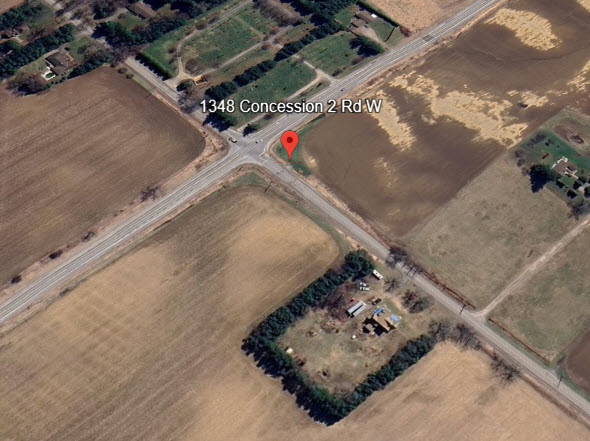 Google Earth image of the proposed site for a 10-hole golf course in Hamilton.
The Forth family, which owns the existing golf course, built it on about 200 acres of underproducing land that was part of the family’s broccoli operation.
That land and its sandy soil “never provided a good yield,” but it was “great for golf in terms of how it drains,” Barry Forth, general manager of the public course, told The AceCall.ai Podcast, a podcast that helps golf course managers use AI, in June.
As part of the application process for the proposed 10-hole addition, the City of Hamilton is allowing the public to weigh in.
Residents have until Jan. 26 to provide feedback.
Gavin Smuk, a local farmer, former president of the Hamilton-Wentworth Federation of Agriculture, and the current vice chair of Hamilton’s Agriculture and Rural Affairs Sub-Committee, plans to participate.
“I farm about four kilometres away from where the proposed golf course would be,” the corn and soybean farmer told Farms.com. “That property has about 63 acres that’s being cropped. They’re proposing to take out some prime agricultural land for purely discretionary use. We’ve got enough golf courses in the area we really don’t need another.”
Hamilton is seeing its number of farmland acres decrease.
In the 2011 Census of Agriculture, 130,589 acres were devoted to agricultural production. In 2016 that number fell to 128,532. And in 2021 it fell further to 118,070 acres, a 2022/2023 report from Invest In Hamilton says.
And overall, Ontario loses about 319 acres of farmland per day, a report from the Ontario Federation of Agriculture says.
The trend of good farmland being taken out of production is a major concern for multiple reasons, Smuk says.
“People will buy a piece of farmland and sit on it and not look after it as well as someone in ag might,” he said. “On top of that, land in this area is already expensive, and when farmland is converted for other uses it makes land more expensive. You can’t buy a farm and be profitable unless you’ve got a lot of help or are already established in the industry.”
On its website Copetown Woods says its proposed expansion “maintains the agricultural character of the land.”