Weed can be harmful to cattle if ingested
By Diego Flammini
Assistant Editor, North American Content
Farms.com
The Ontario Federation of Agriculture is calling on the provincial government to help control the spread of noxious wild parsnip.
“Wild parsnip is a serious concern for farmers right now,” Bruce Webster, an OFA member, wrote on the organization’s website. “Wild parsnip is such a noxious and invasive weed that is causing a lot of concern across eastern Ontario. They can cause damage and loss to crops, seriously affect livestock, invade natural environments and they can be extremely toxic to humans.”
Some of the plant’s characteristics include:
- Outcompeting native plants and reducing biodiversity.
- It contains chemicals that increases skin sensitivity to sunlight.
- It can reduce the quality and saleability of hay, oats and alfalfa.
- It is toxic to cattle, horses and sheep and can reduce weight gain and fertility in livestock that eat it.
Different municipalities, including the City of Ottawa and City of Kington is taking the threat of wild parsnip seriously and implementing control measures.
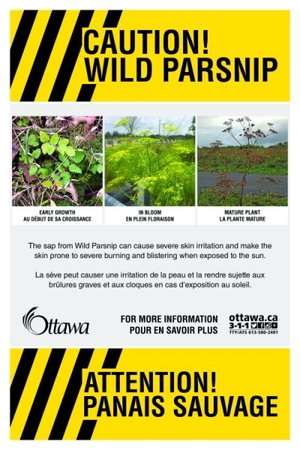
Wild parsnip caution notice
Photo: City of Ottawa
“Spot spraying will continue throughout the summer months as needed within the City of Ottawa,” a public notice says on the City’s website, adding it will use ClearView and Truvist herbicides.
“It is equally important for the government of Ontario to take all necessary measures to control this noxious and invasive weed on provincial lands such as our highway corridors,” writes Webster. “We fully expect individuals and all governments to respect the law and fulfill their responsibility to control these weeds, including wild parsnip. It’s what we need to put the needs of our farm workers, rural residents and Ontarians ahead of this weed.”