The facility features a living roof, and will be constructed with Canadian timber
Attendees of the Ontario Agri-Food Discovery Centre’s (OAFDC) AGM last month received a first look at building design concepts.
The planned 34,000-square-foot science centre in Listowel, Ont., designed by Moriyama Teshima Architects, the same firm responsible for the looks of buildings like the Canadian War Museum and the Honey Bee Research Centre at the University of Guelph, features a living roof with Class 1 soil from the ground the building sits on.
Keen observers will notice the building resembles other ag spaces.
“The goal was for the building to tell a little bit of our story as well,” Steve Dolson, chair of the OAFDC, told Farms.com. “The structure itself, with its shed roof, looks like similar buildings you’d see at livestock facilities across the province.”
The interior of the OAFDC features timber prominently.
This also helps deliver the message of Canadian products, Dolson said.
“Just like the food grown on Ontario farms, the timber is something grown in Canada,” he said. “We’re trying to trace everything back to the land as best we can.”
The entire OAFDC site will take up about 10 acres of land next to the Steve Kerr Memorial Complex.
An observation tower, a dining pavilion, and a main discovery centre are all part of the initial plans.
And an on-site greenhouse will help demonstrate Ontario’s role in producing fruits and vegetables, while the indoor exhibits will highlight other parts of Ontario’s ag sector.
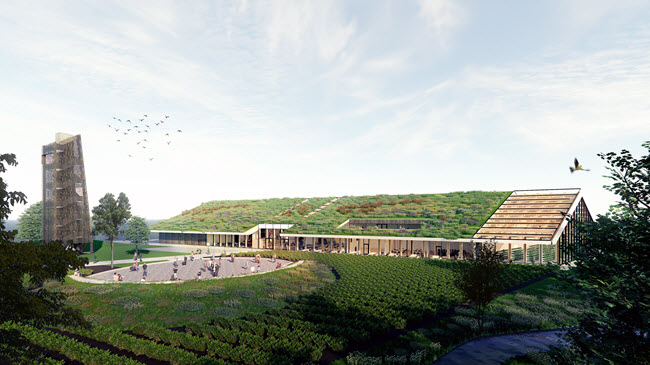
Planned exterior of the OAFDC (OAFDC photo).
Animals won’t be housed on site due to biosecurity risks but could be brought in for special events.
In addition, the plan is for the OAFDC to be available for the community to book for weddings and functions, and to host school trips.
For people outside of ag who visit the facility, Dolson wants them to have fun and educational experiences.
“It’s an interactive science centre and I hope people leave there having a wonderful time learning about something they might have previously been unfamiliar with,” he said. “We want people to understand how important agriculture is to everything around them. For young people, we want to highlight how many careers are available to them working in agriculture.”
For farmers and other members of the Canadian ag industry, Dolson hopes a visit to the OAFDC fills them with pride.
“Farmers should be proud of the work they do, and that we’ll have a space for others to learn about it and appreciate it,” Dolson said. “Also, it could be an opportunity for them to learn about what others in ag are doing that maybe isn’t part of their daily operations.”
The OAFDC’s future includes shovels in the ground by 2029 with a goal of opening the estimated $38 million facility to the public by fall 2030.
Having tangible drawings is the first step to reaching those goals, and others need to be met along the way.
The OAFDC first needs to raise $300,000 for experience planning to help develop a plan for what guests should experience when visiting the facility.
About half of that money has been raised already, Dolson said, adding the plan is to have this portion of work completed by the end of 2026.
The next step after that is to engage in fundraising development.
This would include using the architectural drawings and the experience planning report to make presentations to local businesses, individuals, and government, to provide funding for the OAFDC.
“We’re looking at two years beginning next spring of fundraising and refined development to hopefully meet our targets,” Dolson said.