The Innovative Farmer of the Year’s primary focus is to keep the soil on the land
By Jackie Clark
Staff Writer
Farms.com
Dr. Peter Kotzeff, a veterinarian from Bruce County, has been named Innovative Farmer of the Year by the Innovative Farmers Association of Ontario (IFAO).
“I have a very interesting land base with a lot of unique characteristics,” Kotzeff told Farms.com. Of the 2,200 acres he manages, one half is cash cropped, a quarter is grazed by beef cattle, and the last quarter is left as protected woodland, wetland, and river.
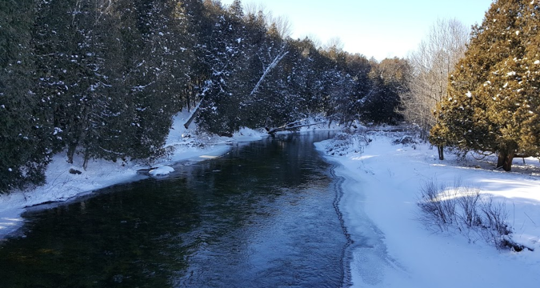
Eight kilometers of the Saugeen River runs through Kotzeff's land.
“It’s sloping land and a lot of it is adjacent to the river, so I have to do things differently,” he explained. “Some of my land base, the best use is grazing, and other parts of the land the best use is leaving it natural. Just because you can do something doesn’t mean it’s the right thing to do.”
Kotzeff’s main guiding principal is to protect soil from erosion.
“The most fundamental issue of soil health is (to) keep the soil on the land, and everything else follows from that,” he explained. He prevents erosion by using minimal tillage, cover crops, and crop residue cover.
“No one can argue that you should not lose your land,” he added. “The base of all soil health is to keep the soil on the land.”
Kotzeff plants overwintering cover crops that his cattle graze, which protects the soil from running off the sloped land into the Saugeen River, and also helps him save $50,000 in winter feed costs.
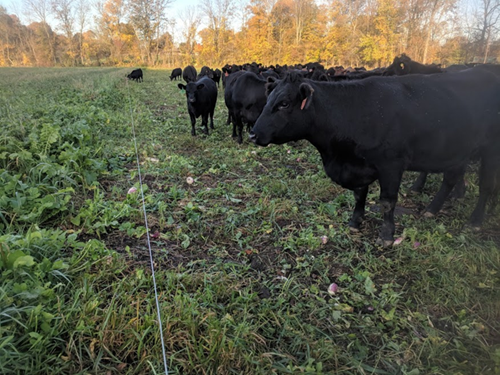
Grazing cover crops allows for improved soil health and reduced feed costs.
In the future, he hopes to continue to innovate.
“I’m going to try to explore using hay as a cash crop to add diversity to my rotation,” he explained. He also wants to “see if I can improve soil and plant health by trying to reduce the amount of herbicides, pesticides and fertilizers.”
Instead, Kotzeff will explore the use of soil inoculants and trace minerals.
“We’re always trying to find ways to improve soil health by reducing inputs,” he explained. That way, the management is a win-win for soil health and his bottom line.
Farmers that are looking to adopt innovative practices on their farm should focus on soil erosion first, Kotzeff said.
“You have to believe in the fundamentals and accept that there’s a learning curve. There’s no real mistakes, it’s just part of the learning curve,” he explained. Benefits of certain practices may be hard to see at first, but pay off in the long run. For example, he had disappointing results the first few times he tried aerial seeding cover crops into soybeans, however, “my sense is that as the soil gets better, it’s more forgiving. Now I can get germination by just putting seed on top.”
For farmers looking for mentorship and information, IFAO “is a tremendous organization … their mandate is the same as mine,” he added.