Farms.com Planting Intentions Survey reveals Ontario farmers planning nearly 3 million soybean acres amid fertilizer costs, drought impacts, and regional shifts
Ontario farmers are planning a modest expansion in total acres for 2026, with soybeans emerging as a key driver of change across the province, according to the 2026 annual Farms.com Risk Management Ontario Planting Intentions Farmer Survey.
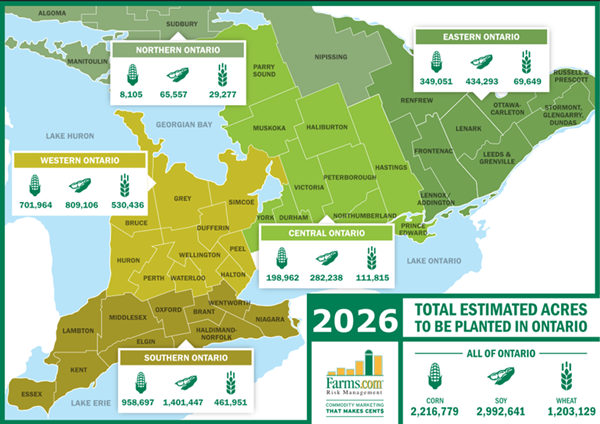
The survey, conducted between January 12 and March 13, 2026, indicates farmers intend to plant 2.99 million acres of soybeans, an increase of 3.6 percent from last year. Corn saw a smaller increase in the 2025 survey, at four percent, while wheat acres remain largely unchanged for the upcoming season.
Collectively, Ontario farmers plan to seed 6.412 million acres of corn, soybeans, and all wheat in 2026, up 1.9 percent, or 119,148 acres, compared to 2025. These figures align closely with Statistics Canada estimates, which project approximately 6.37 million total acres, including 2.9 million acres of soybeans, 2.3 million acres of corn, and 1.17 million acres of all wheat.
Soybeans Continue to Outperform Long-Term Averages
The survey shows soybean acres running well above historical norms. Intended soybean acreage is up 104,441 acres compared to the five-year average of 2.9 million acres, pushing total soybean plantings close to the three-million-acre mark.
Corn acreage in 2026 is projected at 2.2 million acres, up 0.9 percent versus the five-year average, while wheat acres remain essentially flat year-over-year.
Farmers cited several factors behind the soybean shift, including the eastern Ontario drought in 2025, higher fertilizer costs, and storage limitations. For smaller growers who do not operate grain elevators, soybeans remain easier to manage than corn.
Corn Acres Stabilize Despite Higher Input Costs
Despite rising fertilizer prices, corn acreage is still inching higher in parts of Ontario, especially in the south.
“The better-than-expected corn yields in 2025 in Southwestern Ontario with another above average/record final corn crop in 2025 has farmers planting more corn acres in 2026 despite higher fertilizer costs,” explains Moe Agostino, Chief Commodity Strategist at Farms.com Risk Management.
“Its regional, with more corn acres in the Southwest and less in the East. The larger acres are in the South, so we are still seeing some growth in corn acres in 2026 vs. 2025.”
Agostino noted that affordability ratios remain historically high compared to 2022, when fertilizer prices peaked. Although farmers are spending more per bushel due to lower grain prices, stronger corn futures have helped offset rising nitrogen costs.
Wheat Acres Hold Steady
Wheat acres are expected to remain relatively unchanged, dipping only 0.4 percent year-over-year to 1.203 million acres, or 4,471 fewer acres than 2025. This remains above the five-year average of 1.01 million acres.
Agostino said favourable fall planting conditions played a significant role. “Weather last fall was ideal, and it allowed the farmer to plant wheat acres despite the lower prices that have since come back to life and the farmer is starting to make money again with flat prices above $8.00/bushel.”
However, not all wheat classes are faring equally. Hard Red Spring and Soft White Winter wheat acres are down 20 percent and 36.76 percent, respectively.
Identity Preserved Soybeans Gain Market Share
One notable trend in the survey is the continued expansion of identity preserved soybeans. IP soybean acres are up 7 percent, now accounting for 35 percent of Ontario soybean acres in 2026.
“IP soybean acres (up 7% in the survey) are cannibalizing roundup ready soybean acres and edibles,” says Aaron Breimer, Agronomist, Moose Ag. “It’s going to be tough to justify corn acres in heavy clay areas like Niagara with higher fertilizer prices unless you can pencil in 200+ bushels of corn with certainty.”
Breimer noted that while most larger farms have secured fertilizer supplies, smaller operations remain more exposed. “Very few acres have switched thus far but Mother Nature will have the final say and by mid-May if weather is less than ideal more soybean acres will get planted. For the most part the large farmer has secured their fertilizer needs but it is the smaller farmer 600 – 700 acres or less that has not.”
Regional Differences Shape Planting Plans
Planting intentions vary widely by region:
- Southwestern Ontario plans more corn and soybeans and fewer wheat acres
- Western Ontario is tilting toward more corn and wheat and fewer soybeans
- Central Ontario expects a major shift toward soybeans
- Eastern Ontario is planning slightly more corn, slightly fewer soybeans, and more wheat
- Northern Ontario is increasing wheat acres relative to corn and soybeans
Peter Johnson, Wheat Pete, said long-term trends are also influencing decisions in heavier soils.
“I am seeing as time goes on more farmers as they get older a trend to a more soybean on wheat rotation in the heavy clay regions,” Johnson said. “Weather in the 1st week of May will dictate acres and farmers in Lambton and Essex County will plant more soybean acres if the weather and conditions are not ideal.”
Weather, Fertilizer, and Market Risks Ahead
Cash flow issues remain a concern in eastern parts of the province, particularly following drought impacts last year.
“Cash flow has been a challenge in Eastern Ontario after last year’s drought, so fertilizer and higher prices of fuel are a hot topic,” said Paul Sullivam Sullivan Agro. “For the moist part farmers will stick to a rotation but corn and wheat acres are down soybeans up.”
Fertilizer supply remains tight, with 25 to 30 percent of farmers having not booked forward needs. Rising global fertilizer prices, compounded by geopolitical risks in the Middle East, could pressure supply availability later in the season.
Meanwhile, speculative investment remains supportive of grain and oilseed markets, with bullish positions at levels not seen since 2021 and 2022. Ongoing drought risks across North America, strong U.S. soybean oil demand, and uncertainty surrounding U.S.-China trade relations add further volatility.
As spring progresses, weather through May and into early June will likely determine whether Ontario planting intentions hold or shift again. As always, flexibility, economics, and Mother Nature will continue to guide farmers’ final decisions.