Saskatchewan Polytechnic wants to identify the features needed for a mental health support system for the ag sector
By Diego Flammini
Staff Writer
Farms.com
A post-secondary institution in Saskatchewan is looking for members of the province’s ag community to participate in a mental health project.
Saskatchewan Polytechnic, along with the Saskatchewan Center for Patient Oriented Research and the Saskatchewan Health Research Foundation wants to develop an understanding of the mental health resource landscape through the Farmer and Rancher Mental Health (FARMh) initiative.
“We want to determine what Saskatchewan farmers, ranchers and their families require for mental health supports,” Michelle Pavloff, research chair for rural health and principal investigator with Sask Polytech, told Farms.com.
To participate, an individual must be over the age of 18, own or lease his or her farm and be working on the farm. They can be any kind of farmer or rancher from anywhere in Saskatchewan and can have off-farm employment.
Family members can also participate.
The research team includes farmers and family members of farmers.
Having frontline members of the ag community as part of the team means the proper questions are being asked, Pavloff said.
“I was very careful in building the team that we surrounded ourselves with people who understood the topic well,” she said. “No matter where anyone ended up in life, they understand farm life, and that’s a really neat thing about our team.”
The FARMh initiative is divided into two phases.
The first phase, which is ongoing, consists of 30- to 60-minute phone interviews with farmers and ranchers.
Part of these phone conversations will include asking what farm culture is.
Literature from different parts of the world confirm a farm culture exists and it varies based on location, Pavloff said.
“We’re conducting a literature review on the concept of agrarianism and the concept of farm culture," she said. “We know there’s a lot of pride of being in a farming community and being involved in something bigger than themselves. But when it comes to mental health, we also know there’s a lot of stoicism and a lack of ability to express what they need for mental health supports.”
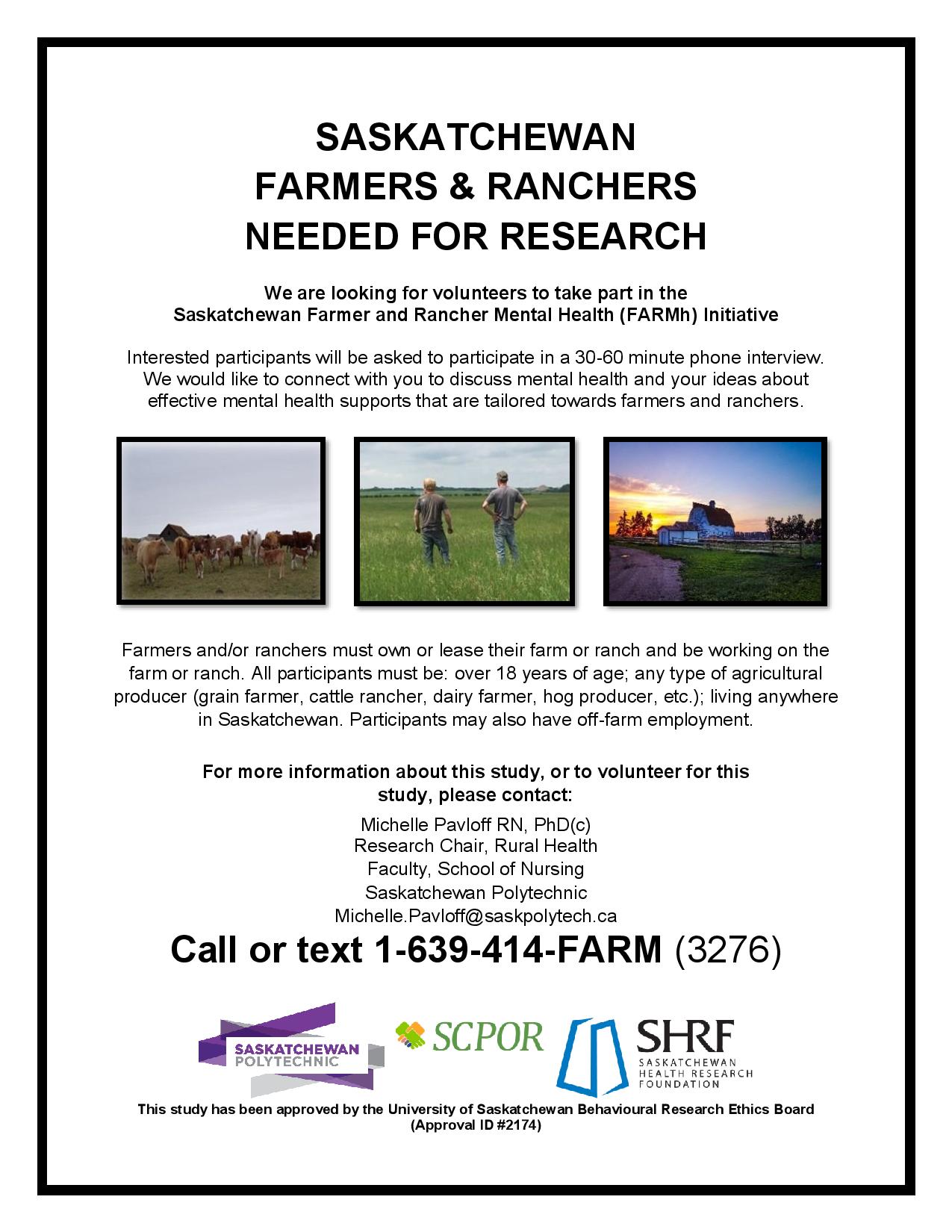
Pavloff’s team initially planned to conduct the phase one interviews in person, but COVID is preventing those visits from happening.
She’s hopeful in-person interviews can be done in the nicer weather because face-to-face conversations lend themselves to better discussions than phone calls, she said.
“It’s important to meet people where they are and form those relationships,” Pavloff said. “We don’t just want to spend half an hour with (farmers), we want to go fix a fence and sit in the buddy seat in the tractor and talk to them about their mental health."
Phase one of the study will run until this fall with the second phase scheduled to begin in early 2022.
Phase two will include program suggestions for ways to support mental health in Saskatchewan’s ag community.
“We want to offer primary care prevention strategies, so farmers don’t end up in an acute care situation where they require immediate medical services,” Pavloff said. “But we have to be aware that sometimes that’s what’s needed, so how do we support someone on the farm who is having an acute medical crisis?”
Once the FARMh team has completed its research, it plans to share its results openly.
The collected information needs to be seen by as many people as possible to ensure no solution goes undiscussed, Pavloff said.
“As a team we feel strongly that there’s a lot of places that need this information,” she said. “We have budgeted for reports to be developed which will be shared as open-access documents. We didn’t want this information to get stuck at academic conferences or in academic journals, all of this needs to be widely available to the public.”
Anyone interested in participating in the FARMh study can contact Pavloff through a confidential number at (639) 414-FARM (3276) or by email.