The National Agricultural Aviation Association is urging both hobbyist and professional drone operators to give the right of way to low-altitude manned agricultural aircraft this growing season.
By Andrew Joseph, Farms.com; Photo by Christian Langenhan on Unsplash
With the North American agriculture industry entering the 2024 growing season, the National Agricultural Aviation Association (NAAA) is asking all uncrewed aircraft system (UAS) operators (or drones) to be mindful of low-altitude crewed (or manned) agricultural aircraft operations.
The NAAA represents the interests of the 1,560 small businesses in the US whose owners and pilots are licensed as professional commercial aerial applicators who use aircraft to enhance food, fiber, and bioenergy production, protect forestry, and control health-threatening pests.
Aircraft and drone agricultural aviators treat 127 million acres of cropland in the US each year in addition to pastureland, rangeland, and forestry, which help farmers increase productivity and protect their crops.
However, when it comes to UAS, they are not allowed above 400 feet without a waiver from the United States Federal Aviation Administration (FAA), and manned agricultural aircraft fly as low as 10 feet off the ground when making an application, meaning they share this low-altitude airspace with drones.
“With the growing number of uncrewed aircraft operations over the last few years, it is critical for their operators to be aware of low-flying, manned agricultural aircraft,” said Andrew Moore, Chief Executive Officer of NAAA. “It is extremely difficult, if not impossible, for manned aircraft to see a drone while conducting crop-enhancing and other aerial applications 10 feet off the ground at speeds as fast as 140 mph. We encourage professional and hobbyist UAS operators to keep this in mind, equip UAS with detect and avoid technology, and give right-of-way to manned or crewed ag aircraft to ensure a safe 2024 growing season.”
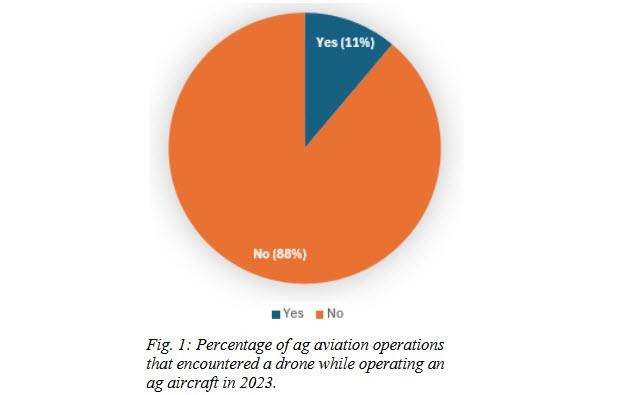
While aerial applications are already underway in many parts of the country, operations nationwide will peak during the summer months. In a survey conducted by NAAA near the end of the 2023 agricultural aviation season, 11 percent of manned aerial application operators reported that either they or a pilot flying for them encountered a drone while operating an ag aircraft last year (see Fig. 1).
NAAA has and will continue to work to educate uncrewed aircraft users and the public about how to use drones safely, especially in agricultural areas. NAAA urges drone operators to do everything they can to avoid manned ag aircraft conducting important low-altitude work.
- Give the right of way to a manned aircraft. It’s the law;
- Equip drones with visible strobe lights, highly visible markings, and tracking technology, like an ADS-B In system;
- Be certified and well-trained in operating an uncrewed aircraft;
- Contact local agricultural aviation operations before flying by consulting the Find An Aerial Applicator database at www.AgAviation.org;
- Land your uncrewed aircraft immediately when a low-flying aircraft is nearby;
- Carry uncrewed aircraft liability insurance.
According to the FAA, drones are the fastest-growing segment of aviation in the US. As of October 2023, there were nearly 864,000 drones registered with the FAA and over 330,000 certified remote pilots.”
Small UAS can be virtually invisible—and potentially lethal—to agricultural aviators, air ambulance helicopters, law enforcement, and other low-flying manned aircraft operating in the same airspace.
In a test conducted by the Colorado Agricultural Aviation Association and other stakeholders, including manned and uncrewed aircraft organizations and the state of Colorado, no pilot operating a manned aircraft could continuously visually track a 28-inch-wide UAS when flying at regular speeds. While they might be spotted for a second, UAS are not constantly visible to pilots, meaning it is up to the drone operator to avoid a collision.
When birds hit an ag aircraft, they can break through its windshield, causing deadly accidents. A study conducted by the Alliance for System Safety of UAS through Research Excellence (ASSURE) showed UAS collisions with aircraft cause more damage than a bird strike of comparable size would, partially due to the uncrewed aircraft’s dense motors and batteries, as opposed to a bird made mostly of water, feathers, hollow bones, and sinew.
The public depends on the continued safe, affordable, and abundant supply of food, fiber, and bioenergy, and America’s agricultural aviators are busy working in the skies to help farmers produce their crops. Ag aircraft are also flying at low altitudes to combat fires and conduct public health applications to eradicate disease-carrying mosquitoes and other deadly pests.
If you’re going to fly an uncrewed aircraft system, be responsible and do everything you can to avoid crewed or manned agricultural aircraft.
Learn more at www.AgAviation.org/uavsafetycampaign and www.Knowbeforeyoufly.org.