By Evan Anderson
Spring has sprung, but it’s not too late for a reminder that soil testing is important. Whatever you grow, from row crops to pasture, proper fertilization is essential for healthy plants. Furthermore, making proper soil amendments, as determined by a soil test, can help you avoid wasting money on products you don’t need and help ensure a desirable yield is achieved. A yearly test will keep you informed on what nutrients are in your soil and how the soil pH changes over time.
The University of Florida’s Extension Soil Testing Lab offers tests that help home and landowners make the best decisions for their individual needs. For bahiagrass pastures, blueberries, and pecan orchards, plant tissue analysis is available to compliment the standard soil test.
To take a soil test, follow these directions:
1.Determine the area or areas to be tested. A uniform field with similar soil conditions throughout may only need one test, while a variable field with differing zones may need two or more tests. Low, damp areas or spots where yields are consistently low are examples of zones that may need their own test.
You may need more than one soil test for a field with variable conditions.
2.Move through the area to be tested and use a shovel or soil probe to take soil from up to 20 different locations for each test – a good representative sample of the entire area is important for accurate results. Take soil from the surface down to the depth the soil is normally tilled, typically 6 inches. For pastures, 4 inches is usually enough, as perennial grass feeder roots are relatively shallow.
3.Pick out any leaves, roots, or other debris from the soil. Mix the soil together thoroughly and spread it out onto a sheet of newspaper to dry. Once fully dry, fill a soil sample bag with about a pint of soil and send it to the lab for testing. Some Extension offices may supply test bags, others may offer to send the sample for you.
4.You can find soil test submission forms with detailed instructions on the UF/IFAS Analytical Services website. The standard sample analysis cost is $10; see forms for details. Results are usually emailed within three working days of the sample’s arrival at the lab in Gainesville.
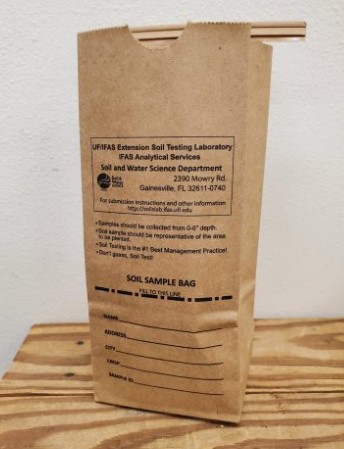
A soil test bag.
Results will give you information on your current soil pH and the amounts of Phosphorous (P), Potassium (K), Magnesium (Mg), Calcium (Ca), Sulfur (S), Copper (Cu), Manganese (Mn), and Zinc (Zn) detected. Fertilizer recommendations for the specific crop(s) you choose are included with the analysis results. Remember, recommendations accompanying soil test results are expressed as pounds of nutrient (N,P,K, etc.) needed, not pounds of fertilizer.
Source : ufl.edu