By Ryan Hanrahan
Reuters’ P.J. Huffstutter reported that “in a sign of growing stress for U.S. farmers, the Agriculture Department forecast on Thursday that U.S. net farm income would fall 0.7% this year, despite near-record government payments that are expected to account for nearly 29% of producers’ bottom line.”
“Net farm income, a broad measure of profitability in the agricultural economy, is forecast to drop 0.7% to $153.4 billion in 2026 from the year before, USDA said,” Huffstutter reported. “When adjusted for inflation, net farm income is projected to decrease by $4.1 billion or 2.6%.”
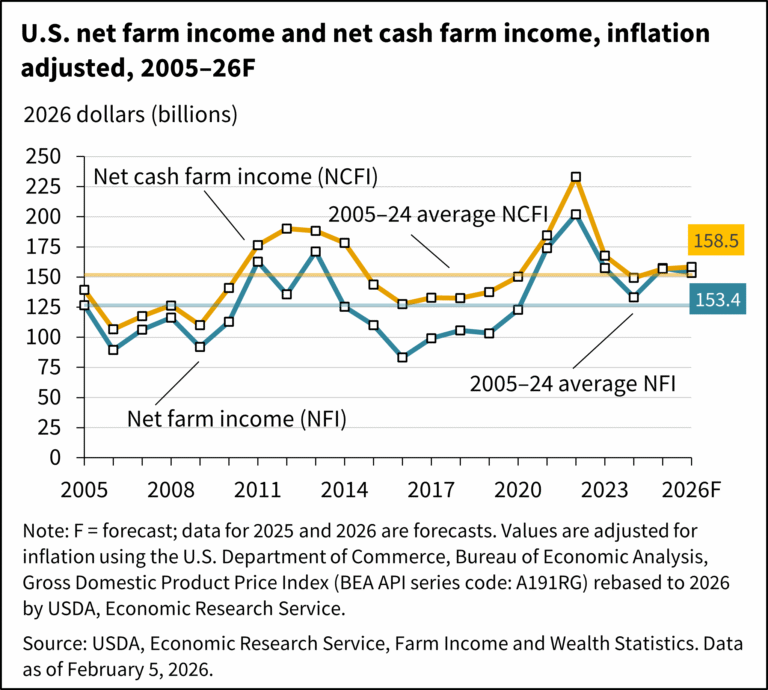
“Without government payments, net farm income this year would fall nearly 12% to $109.1 billion, according to agency data,” Huffstutter reported. “‘Government payments are doing a lot of the work in supporting crop producers,’ said Wesley Davis, a partner at Meridian Agribusiness Advisors, an agricultural economics consultancy in New York City.”
“Many farmers are increasingly dependent on federal support to pay their bills – while also taking on record levels of debt – even as government payments near record levels, economists said,” according to Huffstutter’s reporting. “USDA forecast that producers will receive $30.5 billion in direct payment support in 2025 and $44.3 billion in 2026, excluding additional payouts from federal crop insurance indemnities. Such levels have not been seen since 2020 and 2021 amid COVID-19 pandemic upheaval and trade disruptions during President Donald Trump’s first term.”
Source : illinois.edu