By Laura Lindsey
In general, the best time to plant wheat is the 10-day period starting the day after the fly-free safe date. When wheat is planted more than 10-days after the fly-free safe date, there is an increased chance of reduced fall growth and winterhardiness, but the same yield may be achieved as earlier planted wheat if freezing weather does not occur until late November or early December. However, a higher seeding rate is recommended. According to the Ohio Agronomy Guide, for wheat planted 3-4 weeks after the fly-free-safe date, a seeding rate of 1.6 to 2.0 million seeds per acre should be used.
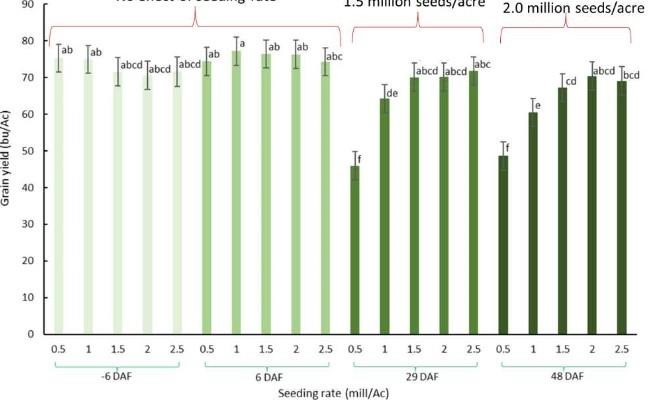
Figure 1. Effect of planting date and seeding rate on wheat grain yield in Wood County during the 2021-2022 growing season. (DAF = Days After Fly-Safe Date)
Our recent research trial in Wood County supports the wheat seeding rate recommendation found in the Ohio Agronomy Guide (Figure 1). In Wood County, there was no effect of seeding rate when wheat was planted six days prior to or six days after the county fly-safe date. However, when wheat was planted 29 days after the fly-safe date, a seeding rate of 1.5 million seeds/acre was needed to achieve the same yield as earlier planted wheat. At 48 days after the fly-safe date, a seeding rate of 2.0 million seeds/acre was needed to achieve the same yield as earlier planted wheat. (This trial is funded by Ohio Corn and Wheat, and we will repeat the study during the 2022-2023 growing season.)
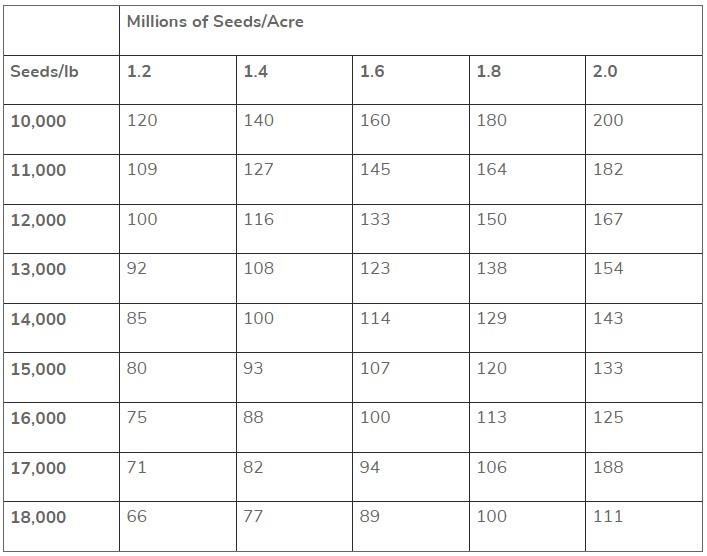
Keep in mind, the actual number of seeds per pound and germination rate are important for determining the correct seeding rate and drill calibration (Table 1). There are fewer seeds per pound of large seeds than pounds of small seeds. The number of seeds per pound can be found on the seed bag. Additionally, late planting also means plants will be smaller than normal when entering dormancy and have smaller, more shallow root systems, making them more susceptible to heaving next March. The best heaving control is to get the seed placed between 1.0 and 1.5 inches deep when planting and to plant no-till. These two practices combined will reduce heaving potential.
Table 1. Pounds of seed needed to plant from 1.2 to 2.0 million seeds/acre with seed of varying size.
Source : osu.edu