By Bryan Runck and Vasu Sharma et.al
Running an irrigated farm is hard business, requiring daily management of sprinklers, pivots, and drip lines to deliver optimal amounts of water to a growing crop. The Irrigation Management Assistant has been helping growers know how much water to apply since 2016 in the Central Sand Plains of Minnesota.
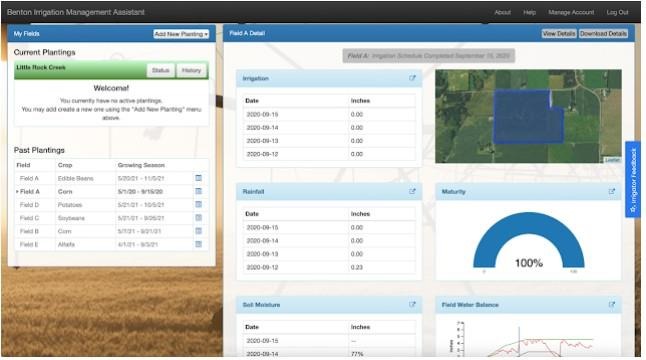
Now, with new funding from Environment and Natural Resources Trust Fund (ENRTF), the University of Minnesota is partnering with RESPEC – a consultancy focused on digital tools for engineering and agriculture – and multiple Soil and Water Conservation Districts (SWCD’s) to update the application so it can support more irrigators across Minnesota. This new funding will allow us to continue to preserve the privacy of irrigators while bringing updated data and modeling to irrigation scheduling.
Access the IMA Tool at http://ima.respec.com.
Background
Since 2002, the use of groundwater for irrigation has increased by more than 33% across Minnesota, such that by 2017 more than 611,000 farm acres in the state were irrigated according to the 2017 USDA Census of Agriculture. The Irrigation Management Assistant or “IMA tool” was developed as part of a 2016 ENRTF project led by Gerry Maciej from Benton SWCD. The Benton SWCD led this work to achieve four outcomes:
- Increased adoption of irrigation and soil conservation practices to reduce water use
- Development and utilization of an irrigation scheduling assistant
- Evaluation of effectiveness and progress towards project goals
- Outreach, promotion, and sharing results throughout the state
Since 2016, the ENRTF-funded Irrigation Management Assistant (IMA) online tool has been adopted by over 100 users in the Little Rock Creek Groundwater area and 5-county expanded areas of Hubbard, Becker, Wadena, Otter Tail and Todd counties. In 2022, Dakota County SWCD also supported the expansion of the tool to their county. These users rely on IMA to schedule irrigation for 5 different crops (corn, soybeans, alfalfa, potatoes, and edible beans) covering roughly 6,500 acres.
Updates to the Irrigation Management Assistant Tool
The success of IMA in these regions and interest shown by other SWCD’s and growers throughout MN revealed the need to expand it to a wider geography. This motivated a 2021 grant led by the University of Minnesota to ENRTF, which was fully funded in August of 2021.
Since 2021, RESPEC and the GEMS Informatics Center at the University of Minnesota have worked to complete a new architecture for the IMA tool. When developing computer applications, the term “architecture” describes the different computing systems and how data will go from the application a user sees to the databases and models that provide irrigation recommendations. Here, we describe the new architecture for the IMA tool so that irrigators know in detail how their data is going to remain secure when the new application goes live in 2023.
When an irrigator logs into the IMA tool, the first thing they can do is define the field they want to manage, the crop that will be planted, and the characteristics of that field. All this data currently resides in databases with limited access by team members at RESPEC. This will stay that way – only RESPEC, and the irrigators who own a field’s data, will have access to that data.
What the new architecture does is provide access to new soils, weather data, and crop models managed by the University of Minnesota. This makes it easier for RESPEC to expand the application to the entire state while preserving irrigator privacy, but still gives RESPEC access to the improved models and data the University can provide. But how does this new application work?
The modern internet runs on what are called “application programming interfaces” or APIs. These APIs allow for computer systems to communicate and share data. The GEMS Informatics Center maintains a suite of APIs via GEMS Exchange.
When a grower enters information for their field, this is all stored on RESPEC servers. RESPEC’s servers then ask University servers to give them the most up-to-date information on that field by sending the field boundaries to a University API without any identifiable information about the irrigator.
The University API’s don’t store identifiable irrigator information sent to them by other computer systems. To increase the speed of queries, the API’s do store submitted geometries for the RESPEC account, but this is account-specific information that is private. Importantly, this means that University systems can’t directly connect an irrigator to a specific field.
Another concern is whether data is safe “in flight”, or when it’s in transmission between RESPEC and UMN servers. RESPEC and the University use the same encryption processes that banks use for securing data in transmission, which means if you trust your bank sending information to your phone, you can trust your data with the IMA tool.
In addition to this technical security, the Minnesota State Legislature worked with the College of Food, Agriculture and Natural Resource Sciences in 2018 to develop a new statute that makes all individually identifiable farm data private, even if it is on University servers. Even though no grower data is stored by the University, this should provide peace of mind that the IMA tool has all the privacy protections in place to keep irrigator’s data secure.
Engaging Irrigators to Improve the IMA Tool
We know that we can always improve the IMA tool to make it useful for irrigators. There have been a lot of requests to update the application over the past five years, ranging from updating how crop progress is modeled and visualized to improving the usability for farmers spanning multiple counties. The ENRTF funds provide developer time to respond to this feedback.
The University and RESPEC are taking two actions to begin responding to this feedback. First, RESPEC has added a new button on the side of the Application. This allows anyone using the application to point out places in the app they’d like to change and to send feedback to developers. Please use it. We’ll collate this feedback and present it to the steering committee for prioritization.
The other way we’re working to be responsive is through the Irrigation Extension program started a new initiative called the IMA Champions. This group of SWCD technicians and farmers will be able to test the new application features before they’re rolled out to all users. If you’re interested in being involved, reach out and we’ll get you on the invite list.
Stitching it Together
The IMA tool is a grassroots application that is supporting many growers in scheduling their irrigation. It is generating a positive impact for both grower’s bottom lines and the State of Minnesota through improved environmental quality. This new funding from ENRTF is allowing us to ramp up this application so it can be of use to more irrigators across the state to ensure improved productivity and environmental quality while preserving irrigator’s data privacy.
Source : umn.edu