Gypsum does not increase soil pH or replace lime products. It improves soil structure and provides calcium and sulfur. Lime is calcium carbonate and its primary function is to increase soil pH.
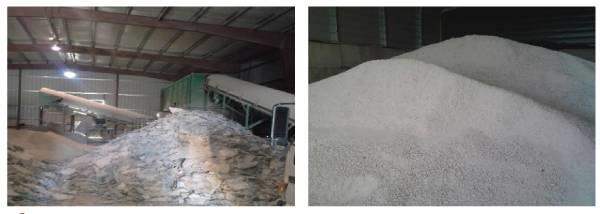
Gypsum rock is mined from deposits and crushed to produce wallboard or soil conditioner for land application. Residual gypsum can be provided through wallboard recycling. Pre or post construction wallboard is ground to produce a fine gypsum product.
Residual gypsum requires a CFIA (Canadian Food Inspection Agency) fertilizer label or a NB Environment and Local Government Approval for agricultural land application.
Gypsum provides calcium and sulfur and if used regularly can decrease soil pH levels. When gypsum is applied to the soil, calcium attaches to the soil, releasing the hydrogen ion. It combines with the sulfur to produce sulfuric acid.
The application rate should be calculated using the facilities residual lime laboratory analysis. Typical application rate is 1-3 tonnes/acre. The
application rate depends on the soils calcium level and the cation exchange capacity (CEC).
Is Residual Gypsum a Good Fit for My Cropping System?
Gypsum is often used for fruit and vegetable production. Soils that are good candidates for gypsum:
• lowbush blueberry production,
• good soil pH levels but low calcium,
• sulfur deficiencies,
• high magnesium or sodium levels.
Gypsum Soil Benefits
(1) Calcium
• engine in the soil responsible for nutrient cycling from the soil into the crop,
• helps crops respond to environmental stressors,
• stimulates root growth,
• improves the structure and strength of plant cells.
NB soils are non-calcareous and are very deficient in calcium.
(2) Sulfur
• important for root growth and seed production,
• cold resistance,
• improves nitrogen and phosphorus efficiency.
Sulfur plays an important role in healthy microbial activity. It helps fungi to remove silica and boron from soil particles for crop uptake.
(3) Soil structure
• improves soil structure and friability,
• improves pore space for better air and water movement,
• reduces soil crusting,
• reduces erosion by binding organic matter to the soil particles.
Heavy clay soils that are high in magnesium have poor soil structure and drain slowly reducing plant growth and vigor. Gypsum displaces magnesium on
the soil particle to help the soil become more porous.
(4) Treat Soil Aluminum Toxicity
In soils with low pH (lower than 4.5), aluminum can be toxic to crops. Sulfate combines with aluminum producing a less toxic aluminum sulfate.
Gypsum Bedding Benefits Extensive research in NS has shown that gypsum combined with sawdust or shavings, significantly decreases mastitis bacteria due to it’s high calcium level.
Source : PEI Federation of Agriculture