By Jennifer Bearden
When it comes to fertilization, applying lime to raise soil pH is one of lowest costs soil amendments. Recently their has been interest in applying liquid lime products to reduce costs, but you have to know the CCE equivalent to compare the costs of alternatives.
Recently, I’ve been asked for my opinion on liquid lime. “Will it work as well as the salesperson says it will? Will it be cheaper?” In this economy, anything we can do to save a few bucks or reduce costs deserves a second glance. I understand the interest in this product. As is typical of most extension agents, I typically respond to any question with more questions…
First question: Is it really lime?
It may be a calcium source, but will it adjust the soil pH? It’s not the calcium raising soil pH, it’s the carbonates, oxides, hydroxides, and silicates attached to the calcium that do the work. Some of the “liquid lime” products on the market are not liming agents at all. One such example is calcium chloride being sold as liquid lime products. Research the product to discover what the chemical make-up of the product is.
Second question: What’s the Calcium Carbonate Equivalent (CCE)?
The CCE is a measure of how effective the liming agent is at changing the soil pH. Calcium carbonate is the standard on this scale at 100%. Anything above 100% will neutralize the soil pH more than Calcium carbonate. Anything under 100% will neutralize less effectively. This is important to know when looking into a new liming agent.
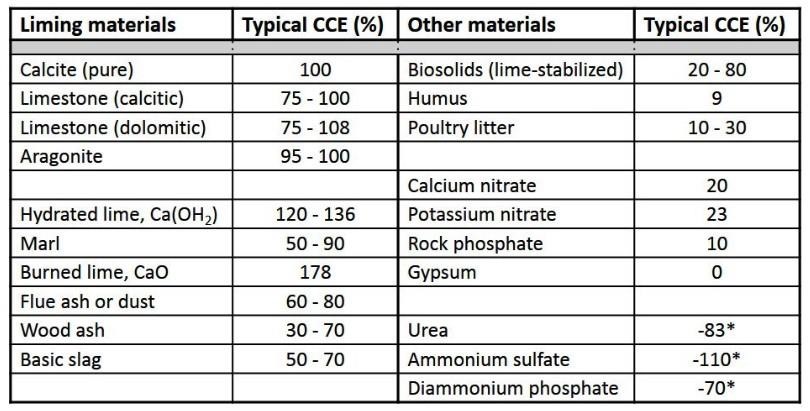
Next question: How much will this cost in comparison to ag lime?
This involves math! No fun for sure, but necessary. This will depend on the cost per acre for the liquid form and the current cost of ag lime application. So this is dependent on the current prices. Another consideration is how quickly the soil pH needs to be changed. Did you soil test early enough to apply ag lime or dolomitic lime? If you need the pH changed quickly, some liquid lime products will act more quickly. Typically, this advantage does come at a cost. Reapplication maybe necessary to keep the pH at the desired level – products that work fast tend to not work for very long. This should be considered when looking at the cost of each product.
There is a lot to be considered when evaluating potential new soil amendments; study the products thoroughly and make sure you are comparing them fairly to the traditional products. More information on this topic is available in the Alabama Extension publication: Choosing Effective Liming Materials.
Source : ufl.edu