Farms.com Home   News

Look Before You Leap: Cautions for Delayed Preemergence Applications in Soybean

By Meaghan Anderson

The beautiful weather this past week means we’ll see a substantial increase in planted acres on this week’s Crop Progress and Condition Report. Farmers should carefully evaluate their herbicide choices before spraying any planted soybean fields that didn’t get their preemergence (PRE) herbicide on ahead of the rain over the weekend. It is always important to read and follow the label – it’s the law after all. Before hitting the fields, check the labels for the herbicides in your PRE mixture to be sure they are still safe to apply.

While most corn PRE herbicides have flexibility to apply after corn emergence, many soybean PRE products are more restrictive on application timing. Some herbicides may only be applied up to three days after planting, including products containing flumioxazin (Valor) and sulfentrazone (Spartan, Authority). Additionally, any product containing metribuzin cannot be applied to emerged soybean in Iowa.

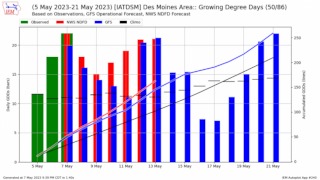
Making PRE applications after planting this year may be especially risky due to the recent rainfall and warm temperatures. Current weather forecasts predict that soybeans planted Friday, May 5 could accumulate nearly 100 growing degree days (GDDs) by Tuesday, May 9. It is likely that some soybean seedlings could be near emergence just 5 days after planting this year.  Soybeans at or just prior to emergence of the cotyledons will be at greatest risk for injury from one of these PRE applications or a rainfall event that moves substantial herbicide onto the seedlings or into cracked furrows.
crop

Figure 1. GDD accumulation estimates on May 5 planted soybean based on two weather forecasts for Des Moines, IA. Source: Iowa Environmental Mesonet Autoplot #240, Daryl Herzmann.

If your planter got too far ahead of the sprayer and you’ll miss the window for your PRE application, alternative options exist to avoid damaging soybean seedlings and provide good weed control. Farmers may choose to switch the above active ingredients to a Group 15-based program with metolachlor (metolachlor), acetochlor (Warrant), dimethenamid (Outlook), pyroxasulfone (Zidua), or mixtures containing Group 14 active ingredient fomesafen (like Prefix) for waterhemp control.

Products containing fomesafen, 2,4-D, dicamba, or glufosinate (Liberty) will be effective in tank mixes if waterhemp has emerged prior to application, and the appropriate choice depends on numerous factors including weather conditions, plant size, and crop tolerance. Numerous Group 2 herbicides are also labeled for early POST. While Group 2 herbicides are ineffective for waterhemp control, they can improve the spectrum of control for other species (particularly large-seeded ones) like common cocklebur, velvetleaf, and giant ragweed.

While the rainfall was beneficial for everyone, get the season off to a great start by making sure your herbicide applications won’t set your soybeans back. Reach out to your Iowa State University Extension and Outreach field agronomist for local recommendations.

Source : iastate.edu

Trending Video

Turning Plant Defense Into a Management Strategy

Video: Turning Plant Defense Into a Management Strategy

Turning Plant Defense Into a Management Strategy

Understanding how a plant responds to stress is one thing.

Using that knowledge to make better management decisions is another.

Systemic acquired resistance, or SAR, is the plant's more direct defense response. When stress or infection occurs, the plant begins signaling throughout its system and preparing defensive compounds.

But if we know that response exists, can we help prepare the plant before the stress arrives?

The answer starts with understanding what triggers the response and what the plant needs to carry it out.

The Trigger and the Fuel

Salicylic acid plays an important role in triggering the SAR pathway.

Think of it as turning the truck on.

The engine may be running, but it still needs fuel to do the work.

In this case, manganese plays an important role in supporting the enzyme systems involved in the plant's defensive response.

This makes manganese status an important part of the conversation. Whether a producer is using tissue testing, sap analysis, or simply scouting for visible deficiency symptoms, the goal is to make sure the plant has adequate manganese available.

Manganese is required in relatively small amounts, but that does not make its role small.

If the plant receives a signal to defend itself but lacks the nutrition needed to support that response, it may struggle to carry out the process efficiently.

The trigger matters.

The fuel matters too.

Prepare Before the Stress Arrives

The best time to think about stress management is before the plant is overwhelmed.

Once a crop is already struggling, management can quickly turn into a game of catch-up.

This is similar to nitrogen management. Once a plant becomes severely deficient, correcting the problem does not necessarily erase the time and yield potential already lost.

Plant defense can work the same way.

Low-rate, targeted approaches designed to support the SAR pathway may fit best ahead of an expected stress event rather than after significant damage has already occurred.

That requires producers to think about predictable stress.

We may not know exactly what the weather will do tomorrow, but we generally know summer heat is coming. We know certain field conditions increase disease pressure. We know a herbicide application can temporarily stress a crop as the plant processes the chemistry.

Even a properly timed and labeled herbicide application can create a temporary response in the plant.

That does not mean the herbicide is bad.

Weeds can create significantly more yield loss than the temporary stress caused by controlling them.

The question is not whether we should eliminate every stressor.

The question is whether we can better prepare the plant to manage necessary and predictable stress.

Not All Stress Is Bad

Stress is a normal part of plant growth.

A perfectly stress-free environment does not exist in the field.

In fact, some stress is necessary for normal plant development. A plant responds to wind, temperature, moisture, sunlight, and countless other environmental signals throughout the season.

The environment is stress.

The plant's job is to manage it.

Problems begin when the stress load becomes greater than the plant's ability to respond.

Extreme heat, drought, high salt concentrations, disease pressure, and even certain management practices can add to that load.

This is where understanding SAR becomes useful.

Instead of waiting until the plant is visibly struggling, producers can begin identifying periods when stress is likely and make management decisions around those windows.

ISR Starts With the Soil

While SAR is a more direct defense response, induced systemic resistance, or ISR, brings the conversation back to soil health.

The longevity of a farm is closely connected to the health of its soil.

Carbon plays a major role because it supports biological life within the soil. Bacteria, fungi, and other organisms interact with plant roots and influence how the plant grows, accesses nutrients, and prepares for stress.

This is why soil health cannot be reduced to one product or one application.

It is a system.

Keeping living plants in the field longer can support biological activity. Cover crops may fit some operations. Better water management can improve soil conditions.