By Ryan Hamilton and Martin Chilvers
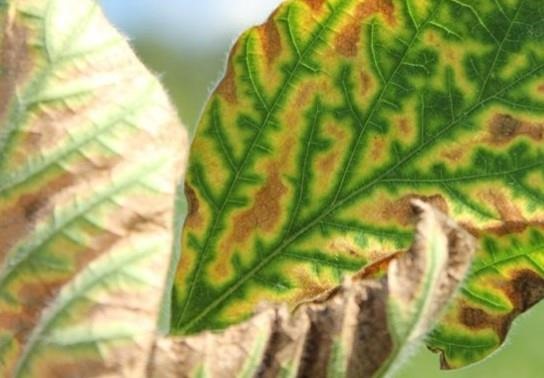
Soybean sudden death syndrome symptoms on a soybean leaf.
Michigan State University researchers are asking for your help to collect soybean sudden death syndrome (SDS) samples from across Michigan. Graduate student Ryan Hamilton is working on the Michigan Soybean Committee-supported project to monitor fungicide resistance in Fusarium virguliforme, the causal agent of sudden death syndrome.
Soybean sudden death syndrome is one of the most important yield-reducing diseases of soybeans in North America. The presence of sudden death syndrome was first confirmed in Michigan in 2010 and severe disease can result in yield losses greater than 50%.
The most noticeable symptoms of sudden death syndrome appear on leaves in the late vegetative through early reproductive growth stages, usually from late July through August, and may be worsened by heavy rains. Leaf symptoms begin as yellow spots between the leaf veins. As sudden death syndrome develops, these yellow spots turn brown, resulting in a mottled appearance while the leaf veins remain green. Shortly after, the leaves die and drop to the ground, while the petiole remains attached. Affected plants appear stripped, and pods and beans may be aborted.
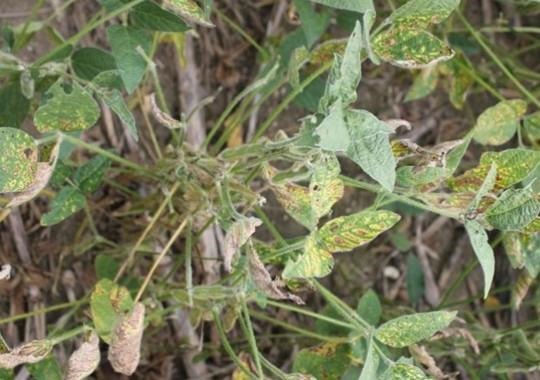
A range of sudden death syndrome symptoms on soybean leaves.
Foliar fungicide applications have no effect against F. virguliforme, but fungicidal seed treatments (ILEVO and Saltro) have been effective in preventing root infection and sudden death syndrome development later in the season. Because approved seed treatments for sudden death syndrome prevention share the same mode of action, monitoring for fungicide resistance is essential for effective long-term management.
Michigan State University Extension is conducting a study to detect fungicide resistance to the seed treatments currently in use. We are asking for your help to collect soybean sudden death syndrome samples from across Michigan. If you have seen sudden death syndrome symptoms in your fields and would like to contribute samples to assist in studying resistance to SDHI fungicides, please send samples to the Chilvers lab at MSU (address below). Information collected from these samples will help in the effective management of soybean sudden death syndrome in Michigan.
To send samples, collect about six whole plants that have shown sudden death syndrome symptoms and allow them to air-dry in a paper bag. Once the plants are dry, the fungus in the roots will be stable, and they can be shipped to:
Chilvers Lab
Attn: Ryan Hamilton – SDS Project
578 Wilson Rd, CIPS 107
East Lansing, MI 48824
Phone: 616-914-0238
Along with the samples, please include the following information:
- Name and email address.
- Nearest town and/or county.
- History of SDS and/or soybean cyst nematodes in your fields.
- Name of seed treatment used.
Source : msu.edu