By Jennifer Howard
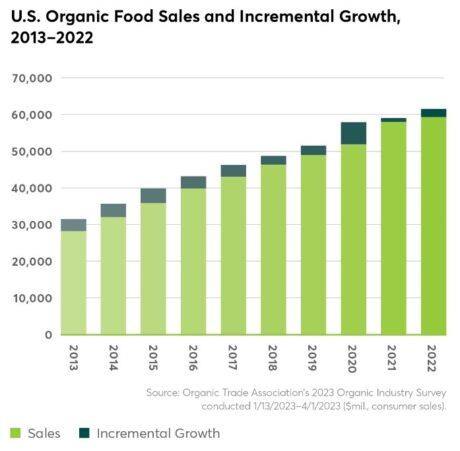
North Carolina reported 335 certified organic farms in 2021, a 4% decline since 2019. But nationally, organic foods are hot, with consistent sales growth that has doubled in the last ten years. Despite increasing consumer demand and the expected 15-50% price premiums, fewer NC farm acres are transitioning to organic production.
A key sticking point is the three-year transition period between starting organic practices and beginning to experience the financial payoffs. In the meantime, farmers may need new equipment, organic certification, and soil improvements to replace conventional methods.
But the biggest hurdle is often the change in mindset and techniques. Organic farming requires different pest control, weed control, crop rotation, and soil management strategies, requiring farmers to learn many new skills. Soil health becomes a vital force.
“Transitions are always the unknown,” said NC State Soil Health Specialist Ekrem Ozlu. “There’s a distinct lag between the practice and the benefits, which can be a deterrent to farmers. We hope to find a way to accelerate the organic transition period in a way that’s economically and sustainably feasible.”
USDA Funds $1M Soil Health Grant
In response to this charge, Ozlu and three partner institutions are leading a new four-year USDA NIFA-funded project to investigate whether living mulches can equally benefit soil health and the farmer’s bottom line.
“Living mulches are dynamic ground covers, cover crops, that protect the soil from erosion, improve soil health, increase biodiversity, conserve moisture, suppress weed growth, and contribute to sustainable soil management practices.“
The four-state group plans to compare multiple cover crop species and whether animals grazing cover crops and living mulches can provide a low-cost means of jumpstarting organic soil health and fertility without significant off-farm inputs.
NC State’s research site will be hosted at the Center For Environmental Farming Systems (CEFS) in Goldsboro, NC. Other partner institutions are Washington State University, Oregon State University and the Rodale Institute in Pennsylvania.
Ozlu says that the potential cash crop benefits of living mulches in an organic system are three-fold: reduced fertilizer costs, reduced herbicide and pesticide costs and increased yield.
“Cover crops bring many benefits to a farming system for free that we usually pay a lot of money for, like soil fertility, weed suppression, water retention and even the soil microbiome. And it’s doubly true in organics. The living mulches we are testing will bring a lot of nitrogen and soil improvements into the system for very little cost.”
Legumes Lead the Way
The group plans to compare the performance of annual and perennial legume cover crops on several soil health metrics, including soil compaction and water retention, aggregate size and soil protein, soil fertility, microbial activity and greenhouse gas emissions.
Ozlu’s NC research site will compare four cover crop mixes of rye with crimson clover, kura clover (a perennial), red clover and white clover on rotations of organic corn and soybeans. He will measure the nutrient content, production efficiency, and competition of each legume’s biomass, as well as the following cash crop establishment and yield.
“Finding environmentally and economically sustainable nitrogen sources is a big challenge for organic producers,” Ozlu said. “We think using legumes as a living mulch across an entire field, not just the crop rows, will reduce the weed seed bank, improve soil health and yield.”
Integrated Farm Dynamics
Cover crops are typically terminated chemically or mechanically. For sustainability, researchers added a low-input twist. Beef cattle grazing will terminate the living mulch, potentially improving soil biology further while adding another farm revenue stream from cattle sales.
Integrated farming systems utilize livestock in conjunction with field crops to create a closed-loop system that eliminates (or dramatically reduces) off-farm crop inputs and instead relies on manures and animal activity to stimulate soil health.
Ozlu says using livestock in an organic system is a soil health multiplier.
“Integrating livestock provides cost benefits to organic producers through labor and fuel savings, nutrient cycling for their cropping system and additional animal products.”
Monthly cattle weights will determine the average daily gain for economic analyses.
Greenhouse Gas Emissions Monitoring
Cover crops are well known for their ability to build soil carbon, which improves soil health. But they can also mitigate agriculturally generated greenhouse gas emissions from fallow soil.
Leveraging expertise and equipment from NC State’s Climate Adaption through Agriculture and Soil Management (CASM) group, Ozlu’s site will be the sole research location to study greenhouse gas fluxes.
NC State CASM’s Alex Woodley specializes in agricultural greenhouse gas emissions.
“When incorporating legumes into a system, we need to consider how the nitrogen fixed by these plants impacts greenhouse gas emissions, namely nitrous oxide,” Woodley said. “There are still considerable unknowns about using legumes as the main nitrogen source to the cash crop compared to other organically certified alternatives like composts or manures. By measuring emissions in addition to the soil health metrics, we will be able to determine the co-benefits or trade-offs of this cover crop management strategy.”
Organic Education for All Ages
Most grant-funded research efforts include an outreach component. Ozlu’s study is no different. He’s planning a new integrated livestock extension portal for digital communications and multiple field day events for growers and extension agents.
However, these researchers see an opportunity to reach a younger audience. They plan to create a grade 6-12 curriculum on organic farming systems.
Interested middle and high school teachers will be invited to a two-day workshop and farm site visits to interact with researchers and help create the course. This pilot group of educators will guide and pilot the curriculum to match national educational standards.
Collaborator Surendra Singh is a Washington State University associate professor and Director of the Lind Dryland Research Station. He will spearhead the project’s curriculum.
“The key reason behind providing organic farming-related education to K-12 is to provide students with an early understanding of “where the food comes from,” but also to raise awareness about organic farming, healthy food, environmental protection, and human health,” Singh said. “We hope that knowing the importance and challenges of organic farming across the country at this early stage may inspire students to be our next generation of agricultural scientists, farmers, policymakers, and/or ag-related careers.”
Big Potential for Smaller Farms
Since livestock (and all the necessary infrastructure) are an essential component of the research design, will that limit the number of growers who can benefit from the results? Ozlu doesn’t think so.
He says the results of this work could benefit NC growers at any scale operation but sees a sweet spot for smaller farms.
“We have a lot of small and midsize farmers in the NC Piedmont who have livestock and are already grazing crops. This study will produce guidelines for how a conventional grower can move into an organic system while understanding the impacts and timeline of how their soil health will respond.”
The first research updates are expected in late 2024 and will continue until the study’s conclusion in 2027.
Want More Pack Impact?
Crop and Soil Sciences’ research impacts farmers, students, and NC citizens through innovations in food, feed, fuel, and fiber. Follow how our discoveries affect agriculture and environmental science by joining our weekly newsfeed.
If you are a student interested in agronomy, soil science or agroecology, investigate our undergraduate and graduate degree programs. Then, join us for a guided email tour of our department and university.
Improving NC’s agricultural economy through diversification is just part of how we are growing the future.
Source : ncsu.edu