By Joe Lauer
Corn planters will soon be rolling throughout Wisconsin and the Midwest Corn Belt. The annual struggle between field conditions being “just right” and not too wet versus delaying planting to another day will start to weigh on farmer’s minds. In addition, planting delays in the northern tier of U.S. states have greater impact on yield due to a shorter growing season and the added dimension (“double-whammy”) of drying costs at harvest that can occur during cool, wet growing seasons.
Figure 1 shows the impact of planting date on relative grain yield at Arlington. If all corn could be planted on one date, ideally it would be on May 1 or slightly earlier to decrease drying costs. Planting delays to June 1 will lower yields about 30%. However, in some growing seasons, 100% of the maximum grain yield can be achieved planting into late May. Grain yield decreases 0.5 bu/A per day on May 15 and accelerates to 2.5 bu/A per day on June 1.
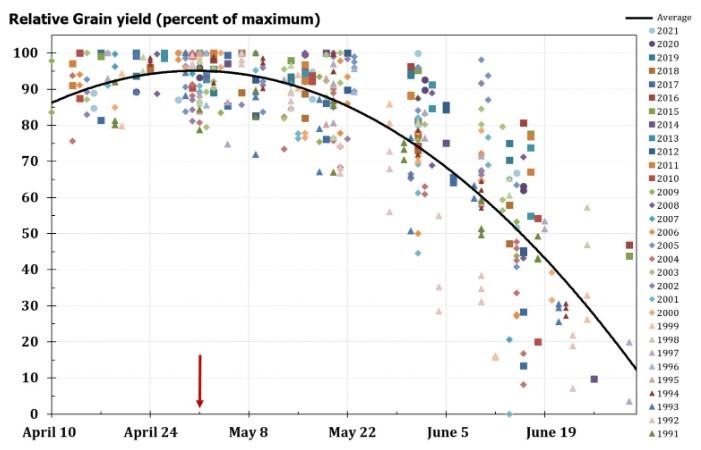 |
| Figure 1. The relationship between relative grain yield and planting date. Data includes all hybrids and trials conducted between 1991 and 2021 at Arlington, WI. Click to enlarge. | |
A similar story emerges for corn forage yield (Figure 2). A good rule of thumb is that, “What you do to maximize corn grain yield, you should also do to maximize corn forage yield.” The ideal planting date to maximum forage yield is May 1. By June 1, forage yield has decreased about 15%. However, many planting dates in June have achieved 100% of relative forage yield in the past. Forage yield decreases 0.2 T DM/A per day on May 15 and accelerates to 0.3 T DM/A per day on June 1.
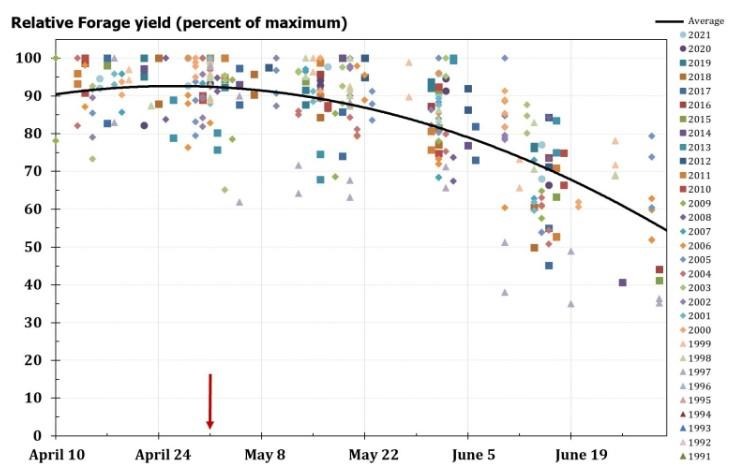 |
| Figure 2. The relationship between relative forage yield and planting date. Data includes all hybrids and trials conducted between 1991 and 2021 at Arlington, WI. Click to enlarge. |
For both corn grain and forage yield, the variability (i.e. risk – spread of the data points around the average) of June planting dates increases. The success of June planting depends upon the growing season. For example, many farmers had success with June planting in 2021, while few had success in 2019. Now is the time to be ready to go, if field conditions allow.
Source : wisc.edu