By Jaime Luke and Jerad Jaborek
In the United States, breeding dairy cows with beef semen was not considered common practice prior to 2017. However, the units of beef semen sold in the U.S. increased 283% from 2.54 million in 2017 to 9.73 million in 2024. Meanwhile, domestic dairy semen sales have decreased by 7.01 million units during the same period. These domestic semen sales numbers reflect the adopted practice of beef-on-dairy crossbreeding by dairy producers in the U.S. A combination of factors such as low milk prices, increased use of female sexed semen, and low prices for male and female dairy calves prompted the adoption of beef × dairy crossbreeding for greater monetary returns for dairy operations.
Data from three recurring USDA Agricultural Marketing Service reports were used to determine price differences between 1) dairy bull calves and beef-dairy cross bull calves, 2) dairy bull calves and beef-dairy cross heifer calves, and 3) beef-dairy cross bull calves and beef-dairy cross heifer calves. These data come from the Farmers Regional Livestock Glasgow Dairy Auction in Smiths Grove, KY; the Monday New Holland Livestock Cattle Auction in New Holland, PA; and the Thursday New Holland Livestock Cattle Auction in New Holland, PA.
Spanning mid-2020 through 2025, 67 months of quantity-weighted average prices were amassed for dairy bull, beef-dairy cross bull, and beef-dairy cross heifer calves for the Kentucky and Pennsylvania sales. For the Pennsylvania sale, calf prices are further broken down into Number 1 and Number 2 grades as defined by the U.S. Grade Standards for Feeder Cattle. Figure 1 plots monthly quantity-weighted prices for each of the three-price series across the three sales.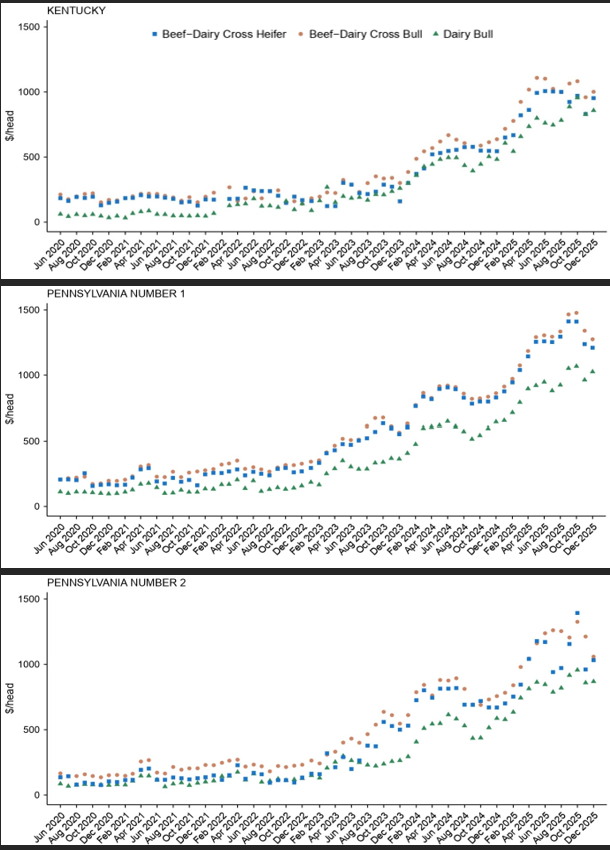
Source : msu.edu