By James Mitchell
Cattle markets have enjoyed supportive supply and demand fundamentals but have also had to navigate several disruptive events, including the announcement by Tyson Foods of the closure of a beef processing plant in Lexington, Nebraska, another Texas beef plant shifting to a single full-capacity shift, and rising detections of New World Screwworm in Mexico (NWS). Both carry important implications for regional cattle prices through processing capacity and trade flows.
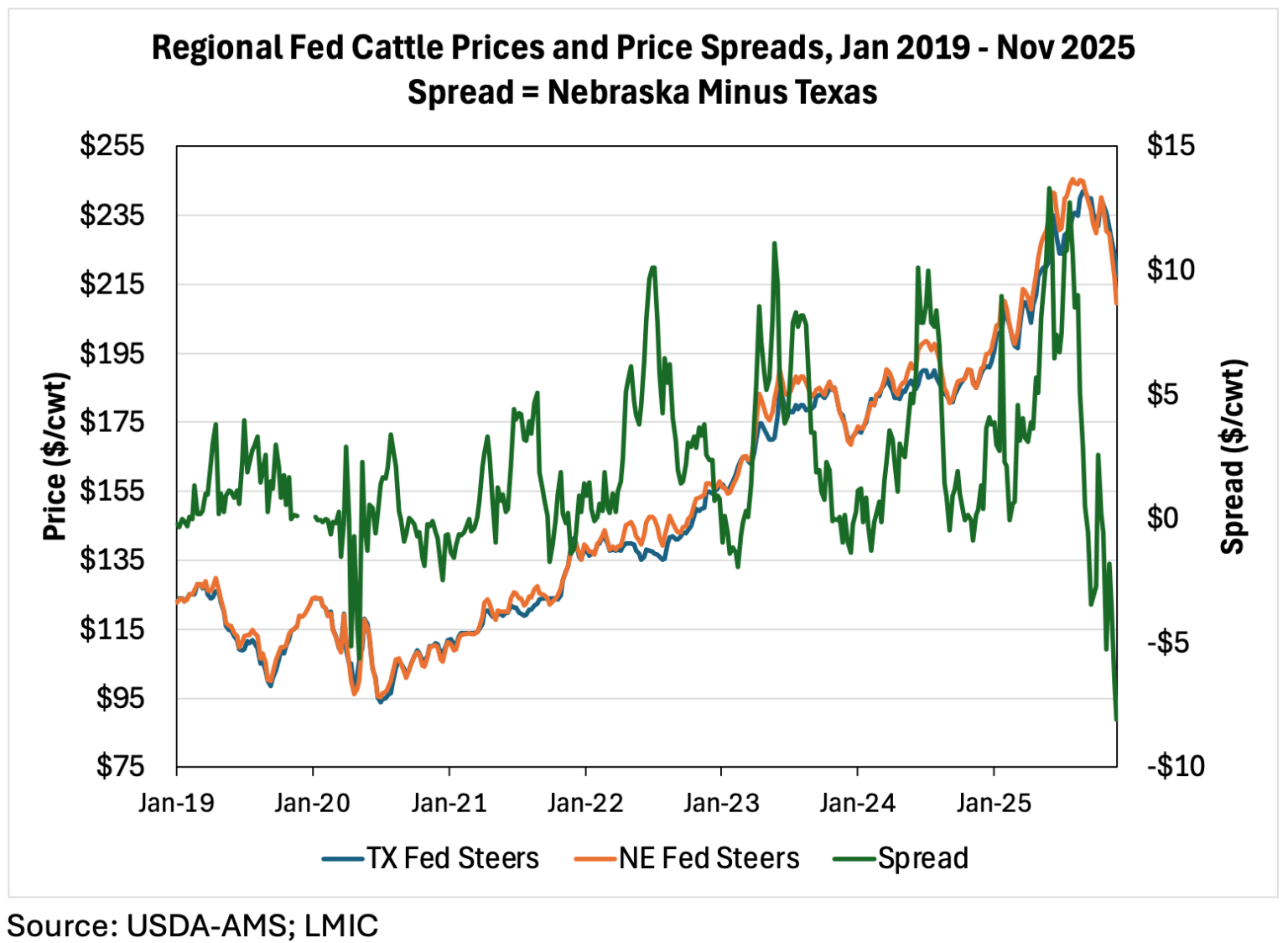
For fed cattle, the closure of the Lexington, Nebraska beef plant and reduced shifts at the Texas plant represent a decline in demand for fed cattle in those regions and, all else equal, place downward pressure on prices. These changes in processing capacity also negatively affect feeder cattle prices, though that impact is lagged. The first graph (above) in this article shows the relationship between Nebraska and Texas fed steers. The spread (green line) is calculated as the Nebraska steer price minus the Texas steer price. A narrowing of the spread reflects stronger prices in Texas, while a widening of the spread reflects stronger prices in Nebraska.
Leading up to the November 21 announcement, we observe a sharp narrowing of the spread, indicating stronger prices in Texas relative to Nebraska that appears to extend beyond typical seasonal patterns. Historically, seasonality in the spread reflects relatively stronger Nebraska prices during the summer months, with prices more closely aligned in the fall and winter. It is important to note that this period was already characterized by extreme market volatility related to trade policy proposals and retail beef prices. It is difficult to disentangle the effects of beef plant closures from other sources of bearish market news. The key point is that a lot has occurred over a short period, all of which has implications for regional fed cattle markets.
More recent news related to New World Screwworm (NWS) has implications going back to fall 2024, when detections in Mexico were first announced and the southern border was subsequently closed to feeder cattle imports. Border closures restrict feeder cattle imports, tightening cattle supplies and supporting prices in Texas, while speculation about reopening the border would have the opposite effect and place downward pressure on prices.
Source : osu.edu