The frequency and intensity of plant stresses have increased in recent years due to climate change. Among them, low temperature is an unavoidable environmental factor limiting agricultural productivity.
γ-Aminobutyric acid (GABA) is a non-protein, four-carbon amino acid that is widely found in all domains of life, including bacteria and eukaryotes. Exogenous GABA can effectively increase plant tolerance to various stresses. However, the specific mechanism of action of GABA in cold tolerance in plants is not clear.
In April 2024, Horticulture Research published a research paper titled "SlGAD2 is the target of SlTHM27, positively regulates cold tolerance by mediating anthocyanin biosynthesis in tomato", a collaboration between Prof. Xiaohui Hu's team at Northwest A&F University and Academician Tianlai Li at Shenyang Agricultural University.
This study first demonstrated that exogenous spraying of 55 mM GABA significantly increased the cold tolerance of tomato seedlings. To further investigate how GABA responds to the process of cold tolerance in tomato plants, this study analyzed the expression levels of GABA synthesis-related genes (SlGAD1-5) under low temperature and found that SlGAD2 responded positively to cold stress.
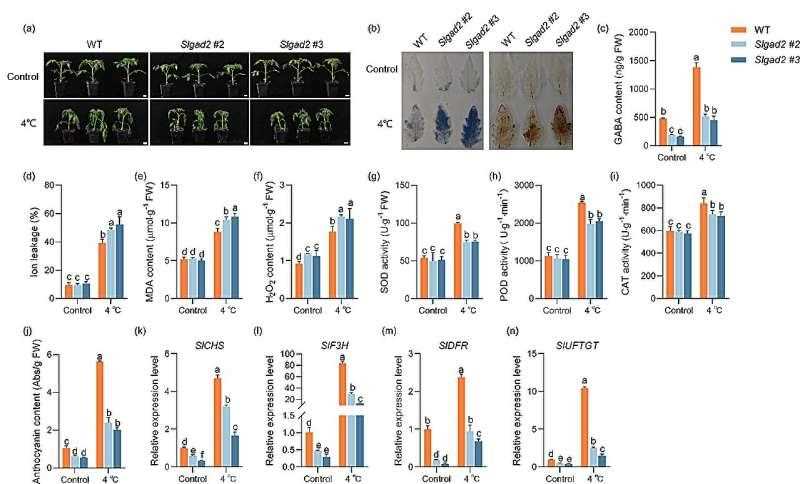
It was shown that overexpression of SlGAD2 increased endogenous GABA levels, reduced the extent of cytoplasmic membrane damage, and improved antioxidant enzyme activities and ROS scavenging capacity, whereas SlGAD2 mutants exhibited a cold-sensitive phenotype. Interestingly, this study revealed that overexpression of SlGAD2 induced anthocyanin biosynthesis in response to cold stress by increasing the level of endogenous GABA.
Furthermore, SlGAD2 expression was negatively regulated by the transcription factor SlTHM27. However, the transcript levels of SlTHM27 were repressed under cold stress. SlTHM27 negatively regulates cold tolerance in tomato by inhibiting SlGAD2-promoted GABA accumulation and anthocyanin biosynthesis.