By Susan V. Fisk
If you’re a gardener, you know that planting seeds in the ground doesn’t always mean you’ll have a good yield at the end of growing season. On a personal level, this can be disappointing. Farmers are in charge of growing dozens to thousands of acres of food. And, they face the same variability in the planting, growing, and harvesting processes as gardeners do.
Agronomists and soil scientists research best practices for farmers to help them make informed decisions on managing their fields and crops. Rintaro Kinoshita and a team of researchers determined that a tool, an “apparent electrical conductivity sensor (ECa),” can give important insights into farm field management.
Kinoshita is an assistant professor at Obihiro University of Agriculture and Veterinary Medicine, Japan, but performed this research while working at Cornell University, United States.
The study was published in Agronomy Journal, a publication of the American Society of Agronomy.
“In larger farms there are factors that limit yield, or cause variations in yield within a field,” says Kinoshita. “Understanding these factors is crucial for optimizing resource investments and financial returns. It also helps avoid adverse environmental effects.”
The apparent electrical conductivity sensor (ECa) was the most successful in estimating soil properties compared to the soil samples taken. These sensors were able to predict soil texture – especially at different depths, and available water content. Since water is the only conducting phase, measurements of soil properties that affect water availability can be predicted using ECa. The measurements related to soil moisture and corn yield, which is valuable information for farmers.
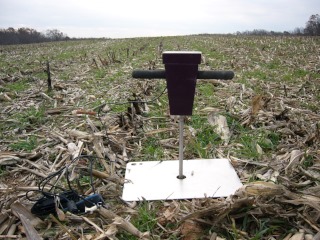
“I chose to use the ECa sensor because it can measure soil properties in deeper layers (subsoils), where it is usually ignored for soil management but a very important reservoir of plant available water, “says Kinoshita. “This can be critical under variable weather conditions, especially drought, to stabilize crop yield and maintain high yield.”
Kinoshita explains it is important to start paying more attention to deeper soils to better manage crops, and for that the ECa sensor can be very helpful in revealing soil conditions that would otherwise be very difficult to see.
Click here to see more...