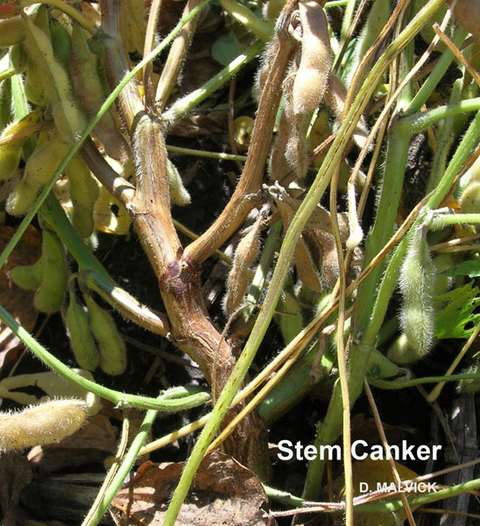
soybeans are grown, but may not be recognized as much as it occurs. Stem canker can kill whole plants or parts of plants. It can be confused with Phytophtora rot. Two different kinds of stem canker are known, northern and southern, which seem to be geographically limited to some degree but their ranges may overlap. Soybean cultivars can have resistance to stem canker. This disease often appears to kill or damage scattered plants, but in some cases large areas can be killed and yield losses can be significant.
Symptoms
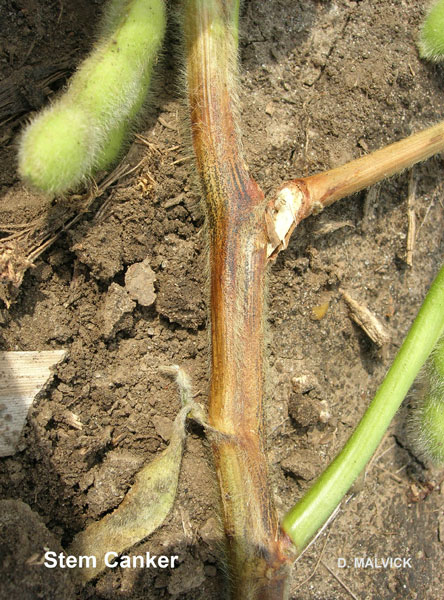
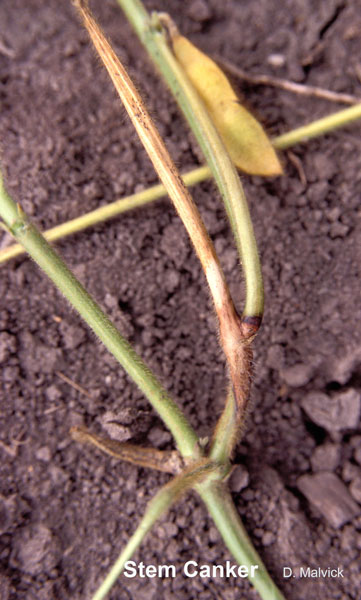
Early symptoms are reddish-brown lesions that appear at the base of branches or leaf petioles. These small lesions can develop into elongated, sunken, dark brown cankers that spread up and down the stem. Tiny black dots called perithecia (spore producing fungal structures) may appear on the stem singly or in clustered groups on plants killed by stem canker. Plant parts above the lesions may die. Reddish-brown discoloration may also occur inside the stem, and pods can abort. Leaves may develop necrosis and chlorosis between the veins and may remain attached after death. Lesions often develop at and remain darker at nodes, but may extend to the soil line and create a situation easily confused with Phytophthora rot.
Conditions and timing that favor disease
Prolonged wet weather, especially early in the season favors stem canker. Symptoms are often seen from mid-July to harvest, especially in susceptible varieties. Reduced tillage may also favor this disease.
Causal pathogen
Northern stem canker is caused by the fungus Diaporthe phaseolorumvar. caulivora. Southern stem canker is caused by the related fungus Diaporthe phaseolorum var. merdionalis. These pathogens overwinter in infested soybean residue, and may be spread with infected seed.
Disease management
Stem canker can be reduced by planting resistant varieties with resistance to this disease. Delayed planting and foliar fungicides may be beneficial. Tillage may reduce disease problems in fields where this disease has been a problem. Crop rotation with non-host crops such as wheat and corn may help to reduce stem canker.
Source : umn.edu