A pioneering study of U.S nitrogen use in agriculture has identified 20 places across the country where farmers, government, and citizens should target nitrogen reduction efforts.
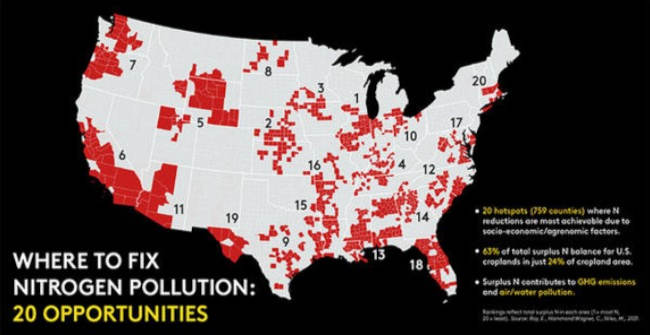
A new study reveals the 20 best places to tackle U.S. farm nitrogen pollution.
Nitrogen from fertilizer and manure is essential for crop growth, but in high levels can cause a host of problems, including coastal "dead zones", freshwater pollution, poor air quality, biodiversity loss, and greenhouse gas emissions.
The 20 nitrogen "hotspots of opportunity" represent a whopping 63% of the total surplus nitrogen balance in U.S. croplands, but only 24% of U.S. cropland area. In total, they comprise 759 counties across more than 30 states, finds the study in Environmental Research Letters.
The top-ranked hotspot to target, based on total excess nitrogen, is a 61-county area across Illinois, Indiana, Missouri and Wisconsin. That's followed by a 55-county region in Kansas and Nebraska in second place, and 38 counties in Iowa, Minnesota and South Dakota in third. (Click for a full list of the 20 regions).
Several of the 20 hotspots--with high nitrogen balances per acre--surprised the researchers, particularly in the West--including a 32-county hotspot in Idaho, Montana, Wyoming and Utah--and the South (six hotspots across Texas, Louisiana, Mississippi, Alabama, Georgia, and Florida). Also on the list are chronic nitrogen problem areas, such as the Mississippi River Basin, Chesapeake Bay, and California's Central Valley.
"This study provides new perspective on where to focus efforts to tackle America's nitrogen problems," says lead author Eric Roy of the University of Vermont. "The U.S. has so many nitrogen trouble zones, and making progress will be easier in some locations than others. That's why this research is important. It reveals where programs aiming to increase the efficiency of farm nitrogen use are most likely to be successful."
First-of-its-kind study
Why these particular 20 hotspots? First, the study shows that nitrogen inputs are so high in many of these areas that farmers can most likely reduce nitrogen use without hurting crop yields. "This is a crucial finding because farmers naturally worry about lower crop yields when reducing nitrogen inputs," says UVM co-author Meredith Niles. "And we don't want to compromise food security goals."
Second--and perhaps most importantly--the study is the first to provide a robust, national analysis of underlying social, economic and agronomic factors linked to nitrogen balances on croplands at the county-level. That makes it one of the most comprehensive studies of U.S. nitrogen use to date.
Examples of these underlying factors include climate change beliefs, crop mix, precipitation, soil productivity, farm operating expenses, and more.
Click here to see more...