By Dirk Maier and Kristina TeBockhorst
Unloading grain bins and delivering corn to local elevators, feed mills and ethanol plants has been in full swing for several weeks across the Midwest. In this article, Dirk Maier, professor of agriculture and biosystems engineering with Iowa State University Extension and Outreach, provides some basic safety guidance.
Ideally, corn will gravity flow into the center floor outlet (sump), is transferred with an under-floor conveyor out of the bin and from there to another conveyor that fills a truck or to an overhead load-out bin to gravity-fill a truck.
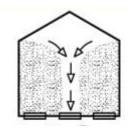
A typical grain bin will unload as “last-corn in, first-corn out.” The only grain moving when the center floor outlet is opened is about a two-foot diameter core of corn that is supplied from the grain surface. All grain outside this small diameter core of flowing corn is at rest until the inverted cone reaches the center well and gravity-flow stops.
Gravity-flow also stops any time during unloading when a chunk of spoiled grain reaches the floor outlet and plugs it.
Given that most spoilage occurs during storage because corn was left peaked and uncored after bin filling, surface crusting and peak hardening are the primary reasons that chunks of corn plug floor outlets.
“This is why when someone starts a bin unloading effort, plugging of a floor outlet will occur soon after,” said Maier. “This results in maximum danger when someone enters a grain bin to attempt to unplug a floor outlet by running a long rod down the center to break up that chunk while leaving the unloading conveying system running.”
As soon as the chunk breaks up and gravity flow commences, the person will be engulfed in seconds and sucked to the bottom of the bin at the flow rate of the unloading system, and with the maximum amount of grain on top of them.
Sadly, such incidents keep occurring, especially this time of year when grain bins are commonly unloaded and grain is delivered to market. In Iowa, an incident occurred just last week when a person lost their life after reportedly being engulfed by grain inside a 20,000 bushel capacity bin.
Two additional grain entrapment incidents reportedly occurred in Indiana during March, that fortunately resulted in the rescue of both individuals. These types of incidents can be tragic; however, they are completely avoidable.
Every grain bin sold and installed in the United States carries a "danger label," which clearly states the dangers associated with entering a grain bin and the steps recommended if someone must enter a bin.
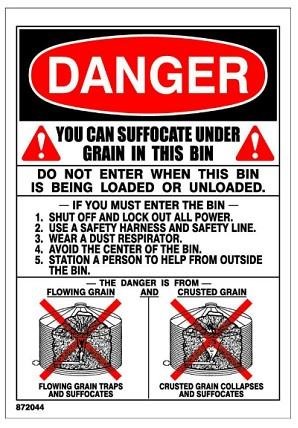
Given the fact that crusted grain occurs on top of the grain mass, it stands to reason that the time to check whether grain crusting has occurred and to attempt to break it up is before unloading of the bin is started. If grain has been removed below a surface crust, do not enter that bin, as your weight will likely collapse the crust, burying and suffocating you.
Therefore, in terms of Step 1, do not turn on unloading equipment before first checking whether grain in the bin has a crusted surface or has a hardened peak due to spoilage. This is the best time to attempt to break up corn that has molded into a thicker layer before it breaks into chunks during gravity-flow and ends up plugging the floor outlet. This avoids exposing yourself or an employee to the dangers from flowing grain, which can entrap and suffocate.
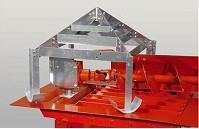
There are devices available that aim to prevent gravity-flow from stopping in a case where chunks of grain reach the floor outlet. They utilize the power of the flow to break up the chunks across the metal grate placed over the floor outlet or fastened to the floor sweep conveyor. Consider installing these if you often have grain spoiling in your bins.
The best practice to prevent unloading issues is to avoid grain spoilage to begin with. The knowledge, practices and tools to achieve that goal exist.
Source : iastate.edu