Soil organic matter (SOM) decomposition is a key process that affects soil carbon storage and greenhouse gas emissions. Investigating the temperature sensitivity (Q10) of SOM decomposition and its regulating mechanisms is important for improving predictions of SOM stability and carbon fluxes under future warming.
Most studies on Q10are based on aerobic conditions, but little is known about how Q10 varies in soils under oxygen limitation. A new study compares Q10 under oxic, suboxic, and anoxic conditions in three grassland soils and reveals the different roles of substrate carbon quality and nitrogen limitation in regulating Q10. The findings were published in Soil Ecology Letters.
Xiaojuan Feng's team at the Institute of Botany, Chinese Academy of Sciences, conducted soil microcosm incubation experiments to test how Q10 varies in three grassland soils at different oxygen levels. They used three oxygen concentrations of 21%, 1% and 0% to simulate oxic, suboxic and anoxic conditions, respectively.
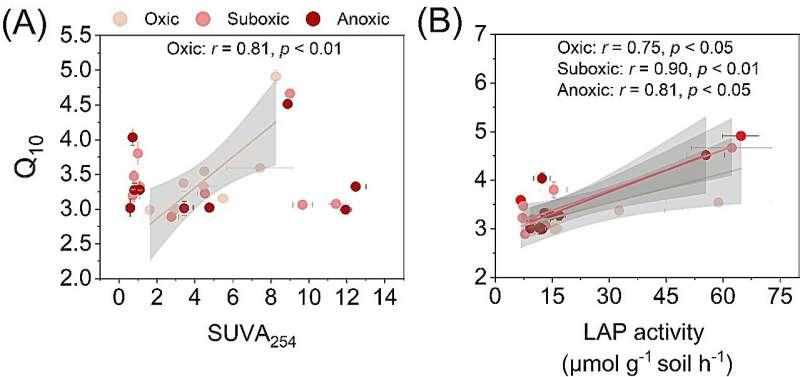
They found that Q10 did not show consistent patterns under different oxygen conditions, suggesting that other factors may override the effect of oxygen on Q10. To delve deeper into these findings, they analyzed the soil properties by conducting a supplementary experiment and found that substrate carbon quality was a strong predictor of Q10 in oxic soils, while nitrogen limitation was more important in suboxic and anoxic soils.
Professor Xiaojuan Feng, the corresponding author of the study, said, "We used incubated soils at varying temperatures to calculate Q10. This method is increasingly popular in estimating Q10, as it eliminates potential complications introduced by varying depletion rates of substrates at different, constant temperatures, which may affect soil C concentrations and microbial biomass in 'equal-time' incubations."
"Our study shows that substrate carbon quality and nitrogen limitation may play roles of varying importance in determining Q10 under various oxygen conditions. This implies that the response of SOM decomposition to warming may differ among soil types and moisture regimes due to differences in substrate availability and quality as well as nitrogen status."