USDA’s Natural Resources Conservation Service (NRCS) is now accepting applications for the Agricultural Conservation Easement Program - Wetland Reserve Easement Partnership (ACEP-WREP). This voluntary program, authorized in the 2018 Farm Bill, provides funding for the purchase of conservation easements to help with restoration of critical wetlands and surrounding upland buffers.
“Conservation easements are a great tool to ensure natural resources are conserved and protected for all Nebraskans,” Nebraska NRCS State Conservationist Robert Lawson said. “We encourage Indian tribes, local governments, non-governmental organizations and private landowners to contact their local NRCS office to find out how to apply.”
The main goal of ACEP-WREP is to restore as well as protect wetlands and wildlife habitat. Cropland, rangeland, grassland, pastureland and nonindustrial private forestland are eligible.
Applications can be submitted at any time, but to be considered for fiscal year 2025 funding opportunities, applications in Nebraska must be received by May 30, 2025.
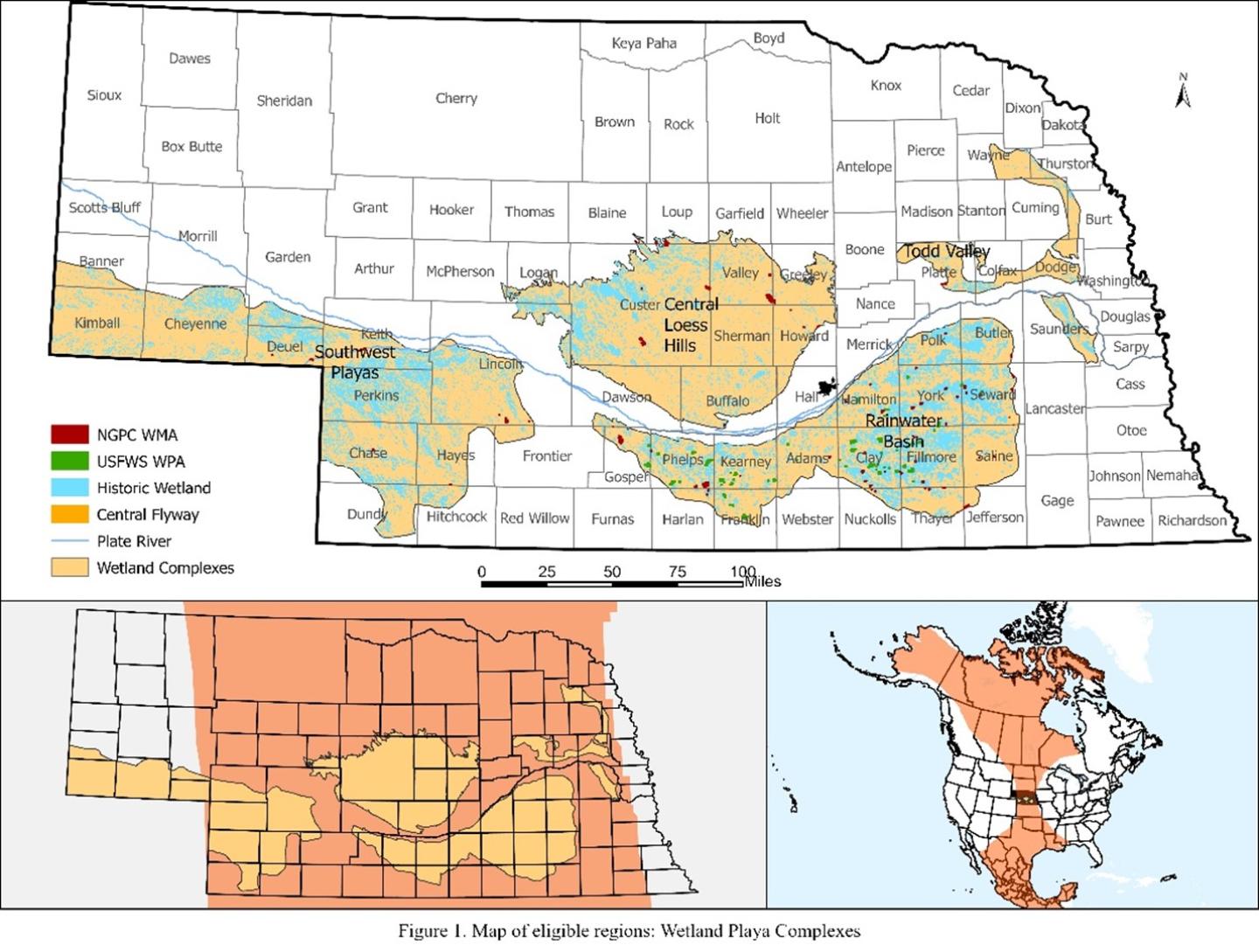
For ACEP-WREP, NRCS is prioritizing the four playa wetland complexes located in Nebraska (see map) known for their importance for millions of waterfowl during spring migration. ACEP-WREP allows for pivots to pass through protected wetland easements with modifications, maximizing crop production and water efficiency on the adjacent crop ground.
NRCS provides technical and financial assistance directly to private and tribal landowners to restore, protect, and enhance wetlands through the purchase of conservation easements. Applications are currently being accepted for ACEP-WREP easements. Eligible landowners may choose to enroll in a permanent or 30-year ACEP-WREP easement. Tribal landowners have the option of enrolling in 30-year contracts.
“NRCS staff will work with all interested applicants to help them through the application process and provide one-on-one assistance to create the conservation easement option that works best for their farming operation,” Lawson said.
All ACEP-WREP applications will be ranked according to the easement’s potential for protecting and enhancing habitat for migratory birds and fish along with other wildlife habitat. Eligible applicants will be compensated with a payment rate comparable to the local land use value. Applicants will need to provide accurate records of ownership and ensure they have established fiscal year 2025 ownership eligibility with USDA’s Farm Service Agency (FSA). Application information is available at your local USDA Service Center and at www.nrcs.usda.gov/GetStarted.
Source : usda.gov