When Jon Eisenback, professor of plant nematology at Virginia Tech’s College of Agriculture and Life Sciences, conducted nematode surveys on vegetables and rice in Cambodia this past August, one of the most surprising things he encountered in the vegetable fields was, in a word, nothing.
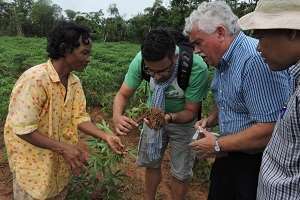
“One of the biggest finds from that trip was almost completely sterile soil,” Eisenback said of the surveys he and postdoctoral associate Paulo Viera conducted in vegetable farms near Siem Reap.
They visited farms growing cucumbers, sweet melons, eggplants, tomatoes, and cantaloupes to assess whether any of them were suffering from nematode invasions, but they found that all the crops were grown under plastic with drip irrigation. They had been covered with so many pesticides that there was nearly nothing living – the soil was essentially ruined.
Plant parasitic nematodes are microscopic roundworms that cause significant damage to many crops. In Cambodia, a country with nearly half of its labor force in agriculture, nematodes can create big problems for food production.
To control the pest, Eisenback and Viera traveled to Cambodia to survey nematodes for two projects under Virginia Tech’s USAID-funded Feed the Future Integrated Pest Management Innovation Lab.
The Integrated Pest Management Innovation Lab applies integrated pest management solutions to pest problems around the world in ways that use little to no chemical pesticides. Techniques focus on biocontrol and biopesticides to alleviate agricultural pest problems. Eisenback said that the project would increase chances that vegetable farmers in Cambodia would stop the soil-killing overuse of pesticides.
After surveying the vegetable fields in the north, Eisenback and Viera traveled to the south of the country to conduct nematode surveys on rice. Given the dearth of scientific literature published on nematodes in Cambodia relating to rice, Eisenback and Viera weren’t sure what to expect. However, they found that the rice fields they surveyed showed a significant loss of production caused by the rice root nematode.
“Every root we looked at had lesions,” Eisenback said. The culprit was a parasitic nematode called Hirschmanniella mucronata. “Rice roots should be creamy white. These were speckled with brown and orange lesions.”
Eisenback expects that these nematodes could cause a 20 to 30 percent crop loss of rice in affected fields.
The next step is field demonstrations; to undertake them, half the fields should be treated with nematicide to measure the effect. Eisenback also said he hopes to continue the survey to see what other nematodes are there.
“I would suspect that there are other fields with other nematode problems.”
As for the vegetable fields with the sterile soil near Siem Reap, Eisenback offered a recommendation for them as well: Don’t use so many toxic pesticides.
With the Iab's projects up and running in the region, that should soon become less of a problem.
The Integrated Pest Management Innovation Lab is a project of the Office of International Research, Education, and Development, part of Outreach and International Affairs.
Source: vt.edu