By Taro Mieno
For the past two years, I have been involved in an NSF-funded research project titled “RII Track-2 FEC: Supporting Rural Livelihoods in the Water-Stressed Central High Plains.” The overarching goal of this project is to evaluate the potential of microbials and biochar to enhance soil water holding capacity (hereafter, WHC), thereby improving drought resilience in crop production and reducing irrigation demand to slow aquifer depletion. Visit the project website for more details. A key component of this research is assessing the economic viability of these interventions, a task for which I am responsible.
To understand the economic benefits of increasing soil WHC, I estimated its impact on the resilience of crop yields during droughts using county-level yield and soil data. In this blog post, I present preliminary results from this analysis.
Figure 1 displays a map of county-level WHC derived from the USDA-NRCS Soil Survey Geographic Database (SSURGO). The spatial patterns are notable: the Midwest exhibits relatively high WHC compared to other regions, while Nebraska’s Sand Hills stand out for their exceptionally low capacity.
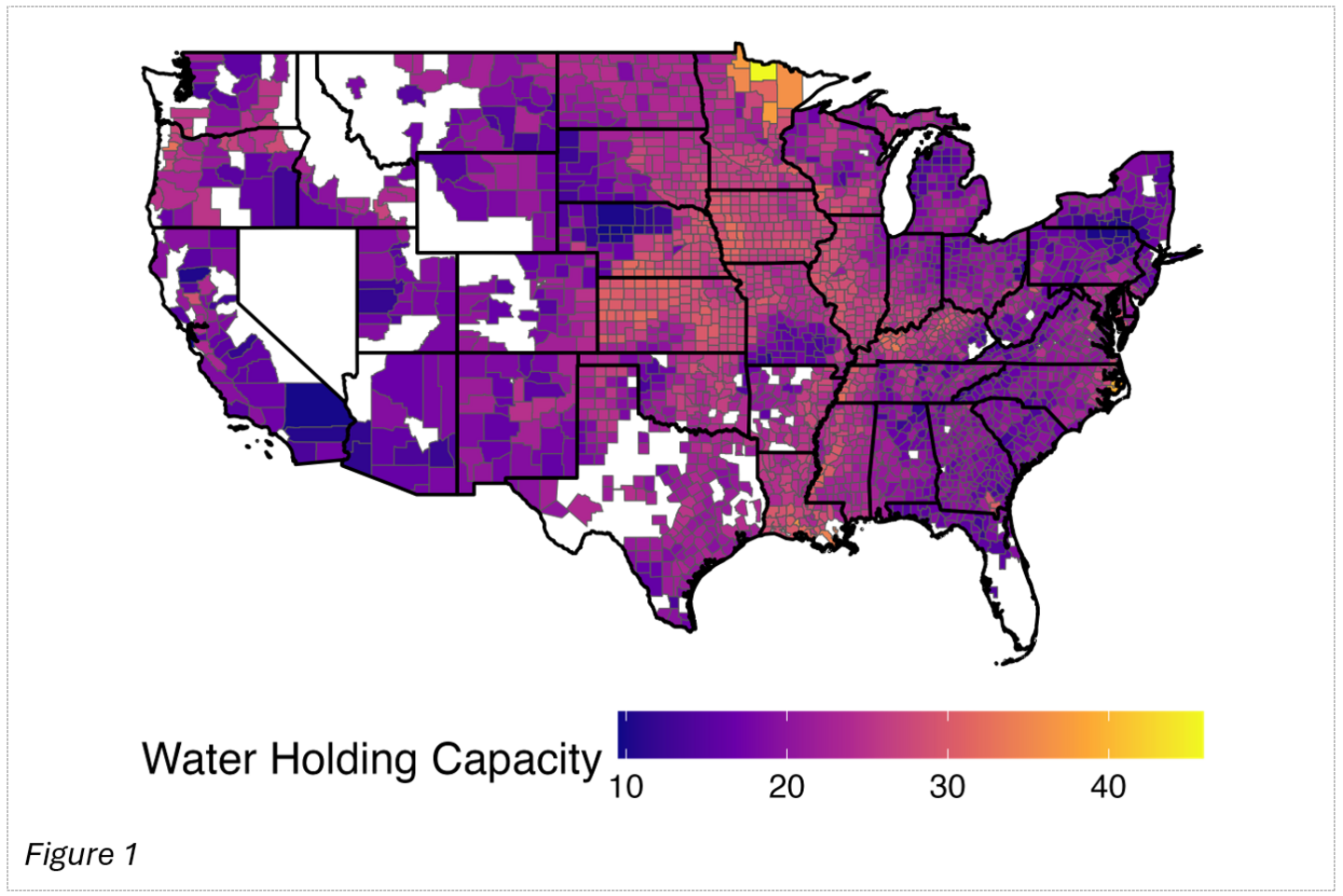
To analyze the effect of WHC on crop yield responses to drought, we integrated soil data with annual county-level corn yield data from USDA-NASS and weather data from gridMET (Abatzoglou 2013). Here, drought is defined as the water deficit, calculated by subtracting precipitation from evapotranspiration during the growing season (April through September). Higher water deficit values indicate more severe drought conditions.
For statistical analysis, we categorized counties into three groups based on WHC:
Low: 10 to 20.6 mm, Medium: 20.6 to 24.9 mm, High: 24.9 to 45.9 mm
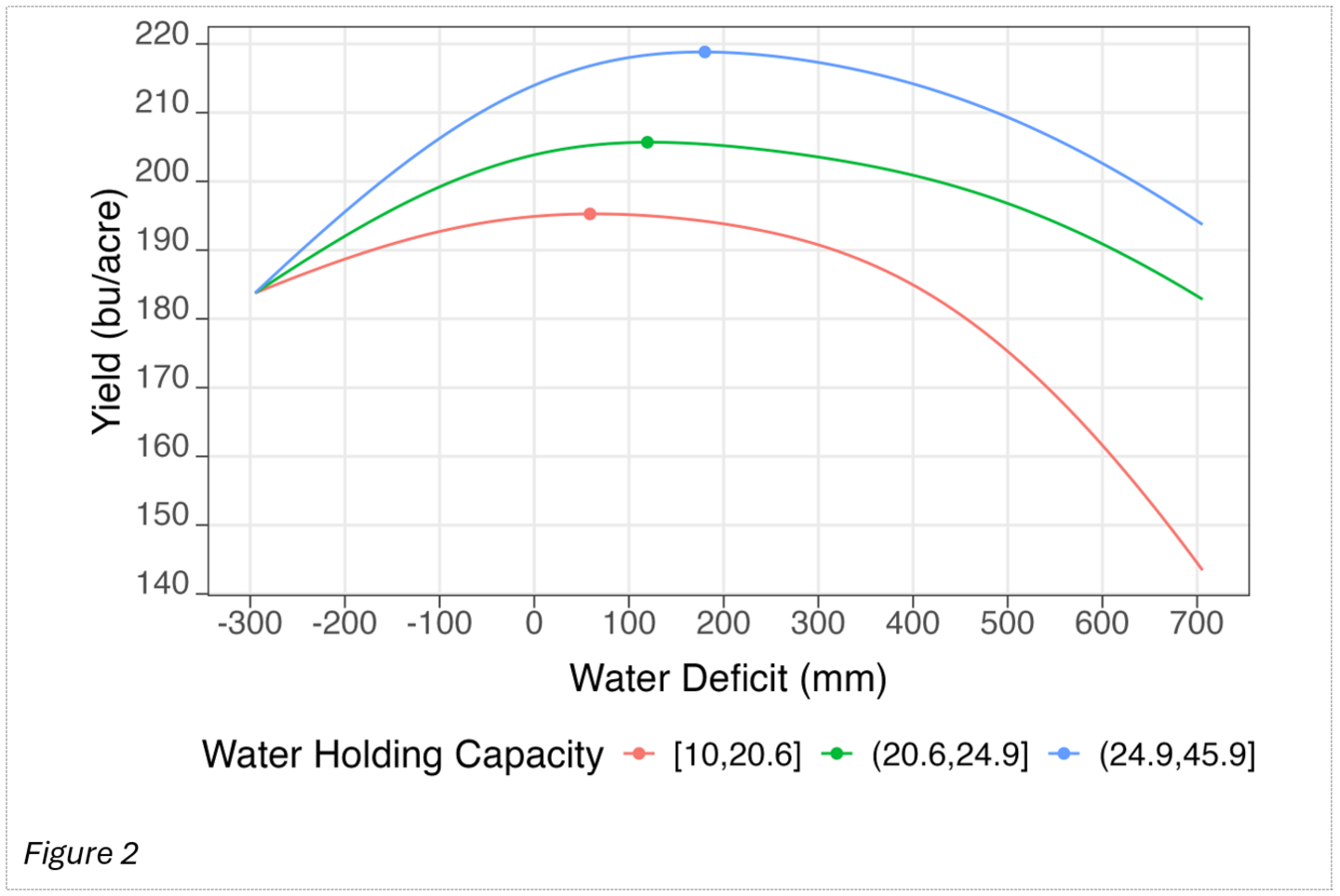
Figure 2 presents the results of this analysis, illustrating how corn yield (bu/acre) responds to water deficit across the three groups. As water deficit decreases from zero, corn yields decline across all groups due to excess moisture. The dots represent the points where yield is maximized for each group. Notably, the water deficit level at which yield is maximized is higher for soils with greater WHC, a result that aligns with agronomic expectations.
As drought severity increases, yield losses become more pronounced, with significant divergence between groups. At an extreme water deficit of 700 mm, the yield difference between the lowest and highest WHC groups reaches approximately 50 bu/acre. Assuming a corn price of $4.50/bu, this translates to a value of $225/acre. In other words, increasing WHC from 10 to 24.9 mm could be worth approximately $225/acre in a severe drought year.
The critical question moving forward is: Can biochar or other soil amendments enhance WHC at a cost lower than the estimated benefit for agricultural producers? If not, what level of cost-sharing or subsidies would be required to make adoption economically viable? These are the questions I will be addressing in the remainder of this project.
Acknowledgement: This research is supported by the National Science Foundation under Grant Numbers 2316295, 2316296, and 2316297. Any opinions, findings, conclusions or recommendations expressed in this material are those of the MICRA project and do not necessarily reflect the views of the National Science Foundation.
Abatzoglou, J.T. 2013. “Development of gridded surface meteorological data for ecological applications and modelling.” International Journal of Climatology 33(1):121–131. Available at: https://rmets.onlinelibrary.wiley.com/doi/abs/10.1002/joc.3413.
Source : unl.edu