Much of the discussions revolved around trade relationships
By Diego Flammini
Assistant Editor, North American Content
Farms.com
Ultra-filtered milk trade highlighed the conversations between U.S. Secretary of Agriculture Sonny Perdue and Canadian Minister of Agriculture Lawrence MacAulay during their first official meeting on June 5 in Toronto.
Other discussion topics included NAFTA, but Perdue voiced his concerns with Canada's Class 7 designation and the potential impact it could have on the U.S. dairy industry.
“…I made it very clear that the Class 7 designation we felt was an unfair undercutting of the U.S. industry that grew up south of the U.S.-Canada border,” Secretary Perdue said in a June 5 release.
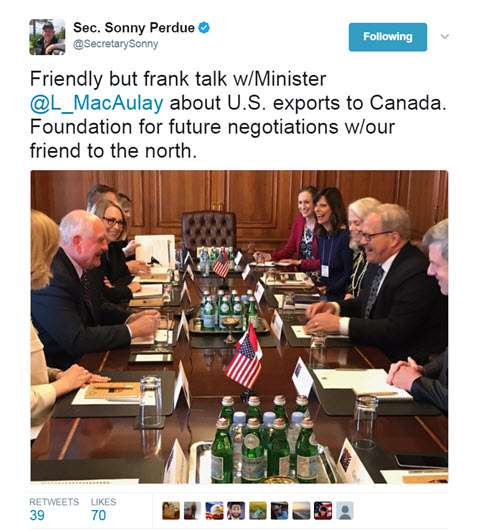
Photo: Sonny Perdue/Twitter
“It cut these (American) producers and this industry out of shipping the ultra-filtered milk into their (Canadian) cheese industry, which was in demand in Canada. I also said, if you want to manage your dairy supply with supply management, that’s fine. You just need to manage it and not overproduce to create a glut of milk solids on the world market that’s being dumped at unfair prices.”
Minister MacAulay outlined Canada’s commitment to working with the U.S. Administration to help the agricultural trade relationship, worth US$47 billion in 2016, flourish.
"I look forward to working closely with Secretary Perdue and the new U.S. Administration to further strengthen our important agricultural relationship,” Minister MacAulay said in a June 5 statement.
“Canada will continue to develop our ties with the U.S. in areas including trade, science, regulations and the environment. I'm confident that we can reinforce this relationship in a balanced manner, allowing us to boost farmers' bottom lines and create good, middle class jobs on both sides of the border."