FCC’s Farmland Values report shows Manitoba had the highest provincial increase
Canadian farmland values increased by nearly 10 per cent in 2025.
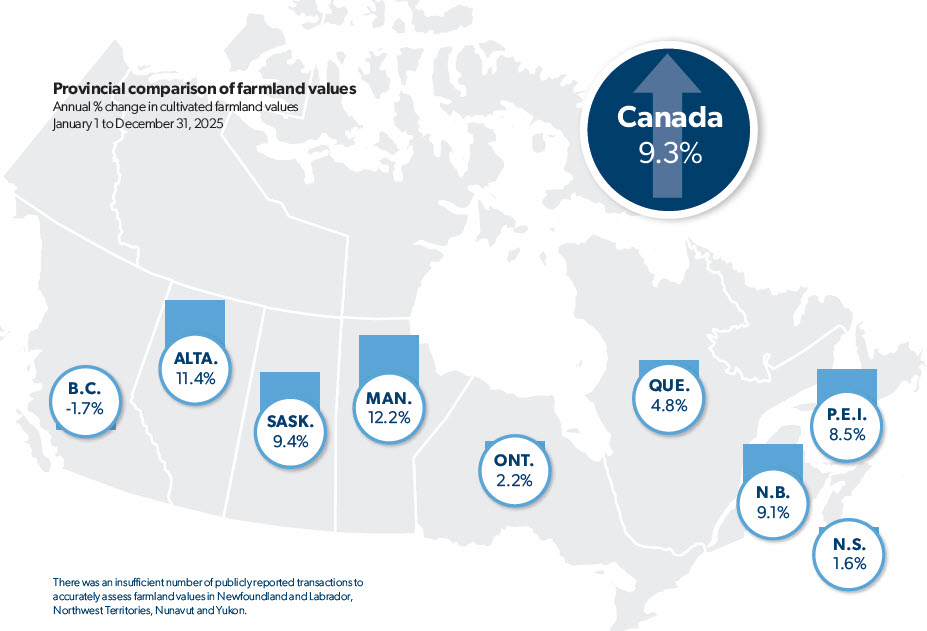
Farm Credit Canada’s Farmland Values Report shows overall farmland prices in Canada rose by 9.3 per cent last year – the same rate as they did in 2024.
“My assessment would be that supply of available farmland is tight,” J.P. Gervais, ag production executive vice-president at FCC, told reporters in a briefing while highlighting other factors playing into FCC’s valuations.
Nationally, Manitoba saw the highest individual increase.
Farmland values there increased by 12.2 per cent between Jan. 1 and Dec. 31, 2025.
Regionally in the province, irrigated land in the Westman and Central Plains-Pembina Valley areas were valued the highest topping out around $15,100 per acre.
Alberta’s farmland values were up too.
Farmland values increased by 11.4 per cent, FCC’s report says.
FCC Farmland Values report screenshot.
Irrigated land in Southern Alberta sold for prices as high as $23,500 per acre.
In Saskatchewan, farmland values increased by 9.4 per cent – higher than the national amount.
Regionally, irrigated acres in West Central and South Western Saskatchewan sold for up to $11,700 per acre.
Despite lower commodity prices and overall income levels, farmers are willing to invest in farmland for its future potential, Gervais said.
“I think it’s more from an outlook perspective,” he said. I think there’s still confidence in what the industry brings in terms of the outlook, and I think that explains as well some of the valuations that buyers are willing to attach to the farmland.”
Moving to Ontario, that province experienced a minor increase in farmland values.
Acres in Ontario were up by 2.2 per cent in 2025.
It appears farmers are becoming increasingly selective when making these investments.
“The most notable shift in the Ontario market has been in buyer behaviour. Buyers have become increasingly particular, paying strong prices for high-quality cultivated land while avoiding marginal properties, with some preference being given to tiled land,” FCC’s report says. “Purchases were less reactive, as established players were making deliberate, well-considered acquisitions.”
Northern Ontario had the highest regional increase at 10.6 per cent.
This brought the value range in the area as high as $12,100 per acre.
The most expensive farmland in the province is in Central West, with higher values reaching $50,000 per acre.
Quebec, P.E.I., New Brunswick and Nova Scotia all experienced increases in farmland values ranging from 1.6 to 9.1 per cent.
Only British Columbia saw its farmland values decrease.
Overall farmland values in the province dipped by 1.7 per cent in 2025 after seeing an 11.3 increase in 2024.
Regionally, the Kootenay area of B.C. saw a 21.1 per cent decline in land values.
This can be attributed to challenges in the fruit industry.
“Efforts to establish a fruit-growing region faced ongoing challenges, and prolonged production difficulties led many growers to exit the market,” FCC’s report states. “As fruit operations declined, downward pressure extended beyond orchard properties to cultivated land values.”
The 9.3 per cent national increase extends the country’s overall farmland values trend.
Farmland values in Canada have increased each year since 1993. The highest increase between 1993 and 2025 came in 2013 when values jumped by 22.1 per cent.