Canadian Farmland Values Rise 3.8% in 2026 as Market Shifts Toward Selective Buying.
Canadian farmland values continued their upward trend during the first half of 2026, although growth has moderated compared to the rapid gains seen in recent years.
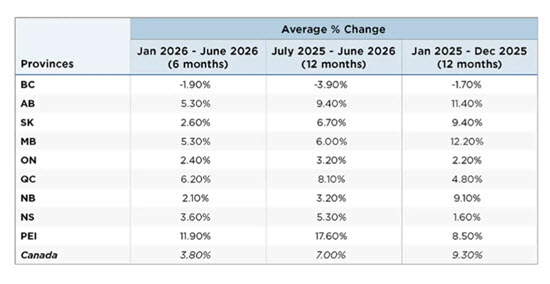
According to Farm Credit Canada's (FCC) mid-year farmland values review, cultivated farmland increased by an average of 3.8 per cent nationally between January and June 2026. That compares to a 6.0 per cent increase during the same period in 2025. Over the 12-month period from July 2025 through June 2026, farmland values rose 7.0 per cent nationally, down from the 9.3 per cent increase recorded during the previous 12-month reporting period.
The latest numbers suggest that while farmland remains a highly sought-after asset, the pace of appreciation is becoming more measured as farmers navigate a more challenging economic environment.
"The pace of growth has eased from last year, but Canadian farmland values continue to show resilience," said Craig Johnston, FCC's chief economist. Higher production costs, tighter margins, and uncertainty surrounding trade, tariffs, and international markets are contributing to a more cautious and selective land market.
Regional Differences Important
One of the key themes emerging from the report is the growing importance of local market conditions.
Rather than moving uniformly across the country, farmland values are increasingly influenced by regional economics, production potential, and the business needs of individual farm operations. Productive parcels located in strong agricultural regions continue to attract buyer interest, while less strategic properties are drawing more selective bidding activity.
Prince Edward Island posted the strongest increase during the first half of 2026, with farmland values climbing 11.9 per cent. Quebec followed at 6.2 per cent, while Alberta and Manitoba each recorded gains of 5.3 per cent. Nova Scotia rose 3.6 per cent.
Saskatchewan saw a 2.6 per cent increase, Ontario gained 2.4 per cent, and New Brunswick rose 2.1 per cent. British Columbia was the only province to report a decline, with average values falling 1.9 per cent.
For Ontario producers, the results point to a significantly different market than the one experienced during the post-pandemic land boom. FCC noted that demand has become more focused on high-quality farmland and operationally strategic purchases rather than aggressive expansion plans.
Prairies Gain Momentum
FCC's review also examined the farmland growth cycle that began in 2020 and found that growth peaks have not occurred simultaneously across Canada.
The strongest momentum has shifted away from some provinces that led the post-pandemic surge and toward the Prairies, particularly Alberta. Meanwhile, Ontario and British Columbia have experienced some of the sharpest slowdowns from the exceptionally strong appreciation rates seen earlier in the decade.
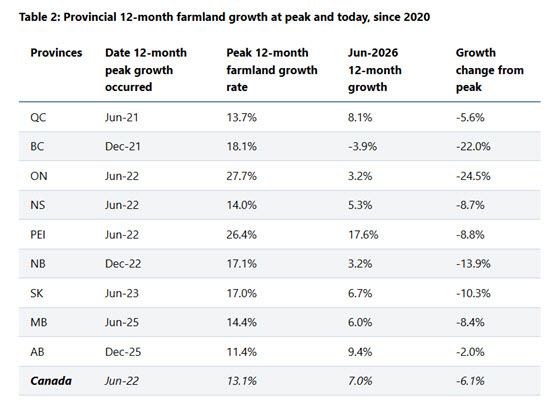
Alberta’s cultivated farmland values increased 5.3 per cent during the first six months of 2026 and finished the year-over-year period up 9.4 per cent. The strongest gains were concentrated in the North and Peace regions, where a higher volume of sales activity supported value growth.
Other parts of the province recorded fewer transactions, resulting in land prices remaining closer to previous levels. In southern Alberta, limited dryland sales continued to constrain market activity, while irrigated farmland remained a significant driver of land values and influenced pricing on neighbouring dryland acres.
Saskatchewan farmland values posted a more modest 2.6 per cent gain in the first half of 2026 and were up 6.7 per cent from a year earlier, reflecting a market that has cooled from the rapid appreciation seen in recent years.
Limited sales activity across much of the province helped keep values relatively stable as producers navigated higher input costs, tighter margins, trade uncertainty and challenging weather conditions. The West Central region recorded the strongest increase, supported by a greater supply of land for sale and strong demand for higher-quality farmland.
Harvest Conditions Could Influence Land Markets
FCC cautioned that land values heading into 2027 may be influenced by this year's harvest results, particularly across Western Canada.
Johnston noted that Prairie farmland values rose before producers encountered a growing season marked by adverse weather and sharply higher diesel prices. Final yield results and crop quality outcomes are expected to play an important role in shaping land demand and buyer confidence during the coming months.
For farmers considering land purchases, that could mean a market increasingly driven by profitability and operational efficiency rather than broad-based appreciation.
What It Means for Farmers
The latest FCC review suggests Canadian farmland continues to be viewed as a valuable long-term asset, but buyers are becoming more disciplined.
Higher borrowing costs than those seen earlier in the decade, ongoing input cost pressures, volatile commodity markets, and uncertainty surrounding international trade are encouraging producers to scrutinize purchases more carefully. At the same time, limited land availability in many regions continues to provide support for values.
Tables and charts: FCC Calculations