Farms.com Home  › News

Lethbridge College Boosted by $1M for Irrigation Research

By Jean-Paul McDonald
Farms.com

Lethbridge College, a leading institution in applied research, has recently received a significant boost in the form of a $1 million grant from the Alberta government. This funding is earmarked for expanding the college's research capabilities in irrigation science, a move that promises to make waves in the agricultural sector. 

The grant is part of a larger $3.6 million funding initiative from Alberta’s Research Capacity Program College Fund, aimed at enhancing post-secondary research infrastructure across the province. Lethbridge College is one of four institutions benefitting from this program, a testament to its commitment to advancing agricultural technologies. 

This funding announcement was made by Nathan Neudorf, Minister of Affordability and Utilities and MLA for Lethbridge-East. He emphasized the critical importance of water management and agriculture to the region's economy and lifestyle. The minister praised Lethbridge College for its innovative approach to smart irrigation, viewing it as a crucial step towards a sustainable future. 
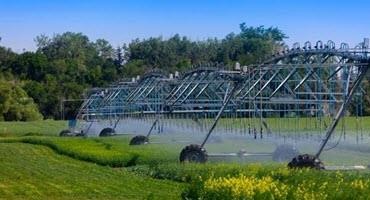
Lethbridge College, a leading institution in applied research, has recently received a significant boost in the form of a $1 million grant from the Alberta government.

The $1 million provincial grant complements an earlier $1 million federal contribution from the Canada Foundation for Innovation (CFI), cumulatively providing the Mueller Irrigation Research Group at the college with $2 million for smart irrigation infrastructure. This funding will be instrumental in advancing the college's research farm just east of Lethbridge. 

Andrew Dunlop, Director of Applied Research Operations at Lethbridge College, acknowledged the significance of these grants. He highlighted their role in facilitating important research collaborations in southern Alberta, which will ultimately benefit the local economy and foster future growth. 

The smart irrigation infrastructure at the college's research farm is a pioneering initiative in Canada. These grants will enable the Mueller Irrigation Research Group to enhance its research capabilities, offering unique opportunities for students, researchers, and industry partners alike. 

Dr. Willemijn Appels, Senior Applied Research Chair, outlined the practical applications of this funding. It will allow for the acquisition of cutting-edge irrigation technology and plant/soil sensing equipment.  

This technology will be used to conduct detailed studies on irrigation management, nutrient and land management, and their impacts on soils and crops. The goal is to derive practical strategies for precision agriculture in irrigation. 

The new equipment will not only improve the college's capacity for laboratory work but will also reduce reliance on external analysis, boosting in-house research and student projects. This initiative is a significant step forward in developing precision irrigation management strategies and optimizing water use efficiency in Alberta's agricultural sector. 


Trending Video

The 15-Year Bet Behind Every New Variety

Video: The 15-Year Bet Behind Every New Variety!


Canada is trying to decide how much agricultural research capacity it can afford to lose. Brian Rossnagel believes the better question is whether the country can afford to rebuild it.

The longtime barley and oat breeder makes the case with a simple fact about his profession: the consequences of today’s decisions may not become visible for 10 or 15 years.

“Pick the right parents. That’s the biggest thing,” Rossnagel says. “If you pick the wrong parents, you’re not going to get anywhere—and you don’t know that until 10 years, 15 years later.”

That warning carries particular weight as Agriculture and Agri-Food Canada moves to reduce spending and streamline parts of its science operations. The department’s 2026–27 plan anticipates the loss of approximately 665 positions by 2028–29 and says some research will be reduced where capacity exists in academia or industry. AAFC says the changes will make its science operations more cost-effective over the long term.

For Canada’s seed industry, Rossnagel’s career illustrates what is at stake.

This fall, the retired University of Saskatchewan breeder will be inducted into the Canadian Agricultural Hall of Fame. During his 35-year career at the Crop Development Centre, he helped develop more than 100 barley and oat varieties, including CDC Austenson—one of Western Canada’s most widely grown feed barleys. His induction recognizes not only those varieties, but the collaboration and research system that made them possible.

Rossnagel is quick to emphasize that none of it was the work of one person.

“The first thing I thought about was all the other people who contributed to whatever success I and my program had over the years,” he says. “We know that it’s not an individual who does this. It’s a group—a team.”

That team extends well beyond the breeder whose name appears beside a variety. It includes technicians, pathologists, quality specialists, statisticians, regional testing sites, seed growers and industry partners. It also includes the breeders who came before and those who will carry the germplasm forward.

CDC Fraser barley, for example, moved through three breeding careers. Its parents came from Brian Harvey’s program. Rossnagel advanced the material after Harvey retired, and Aaron Beattie later guided it through registration and release.

That kind of handoff is normal in plant breeding. The person who makes the original cross may never see the resulting variety reach farmers.

It also explains why lost research capacity cannot simply be switched back on when budgets improve.

“If you shut it off, it’s very, very difficult—and particularly costly—to start it up again,” Rossnagel says. “If you have to start from scratch, it’s going to be at least 10 years before anybody notices whether you’re getting anything done or not.”

The concern is not simply how many experimental lines Canada can process. Modern equipment, statistical tools and genetic technologies allow today’s breeding programs to evaluate tens of thousands of lines—far more than Rossnagel could handle when he entered the field in the early 1970s.

But efficiency and automation do not generate every idea.

“If you pare back down, and instead of having six or seven individual scientists concentrating on wheat breeding, you go down and say three people could handle all this, well, that’s half the ideas gone,” he says. “Particularly if you happen to lose the three people who had the really neat and innovative ideas, boy, that’s a problem.”

It is a timely distinction for Canadian agriculture. Consolidating programs may preserve the volume of material moving through a system, at least initially. It may not preserve the diversity of thinking, regional knowledge or willingness to pursue unconventional crosses.

That regional knowledge matters because Canadian agriculture is not one uniform production environment. A variety suited to southern Alberta may face different disease, moisture and maturity pressures than one grown in Manitoba, Ontario or Atlantic Canada.

“Agriculture is applied biology,” Rossnagel says. “Biology, all around the Earth, moves from the poles to the equator. It does not move from Newfoundland to B.C. like politics do.”