Farms.com Home   Ag Industry News

New report shows decline in Canadian tractor and combine sales

AEM released July 2016 report

By Diego Flammini
Assistant Editor, North American Content
Farms.com

A new report by the Association of Equipment Manufacturers (AEM) shows a decline in Canadian combine and tractor sales.

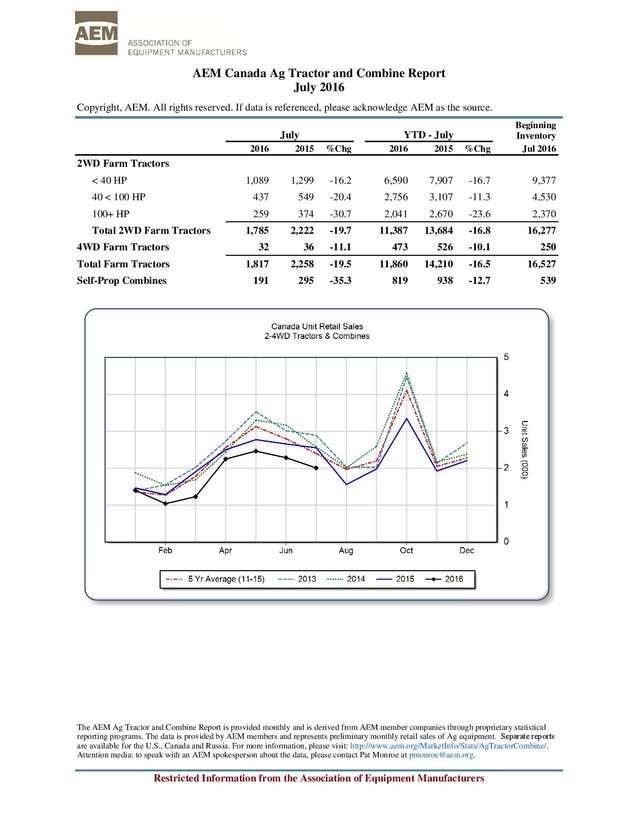
According to the report, 473 4WD tractors were sold in July 2016, compared to 526 in July 2015. That represents a 10.1 per cent decline.

Sales of 2WD tractors fell by 16.8 per cent between July 2015 and July 2016. There were 13,684 sold in July 2015 compared to only 11,387 this July.
AEM July 2016

The report also shows a decline in self-prop combines.

In July 2016, 819 combines were sold, compared to 938 last July. Those numbers represent a 12.7 per cent drop.

The AEM’s report on American combine and tractor sales also indicates a declining market in the same time period.

The largest drops in American sales were in 4WD tractors and self-prop combines. The 4WD tractor sales dropped by 33.6 per cent, and the combine sales fell by 22 per cent between July 2015 and 2016.

HARDI North America CEO Wayne Buchberger said in an interview that commodity prices play a pivotal role in equipment sales.

“That ties directly then to disposable income on the farm and what they’re able to capitalize for expenditures each year,” he said.


Trending Video

Evolution of Beef Cattle Farming

Video: Evolution of Beef Cattle Farming

The Clear Conversations podcast took to the road for a special episode recorded in Nashville during CattleCon, bringing listeners straight into the heart of the cattle industry. Host Tracy Sellers welcomed rancher Steve Wooten of Beatty Canyon Ranch in Colorado for a wide-ranging discussion that blended family history and sustainability, particularly as it relates to the future of beef production.

Sustainability emerged as a central theme of the conversation, a word that Wooten acknowledges can mean very different things depending on who you ask. For him, sustainability starts with the soil. Healthy soil produces healthy grass, which supports efficient cattle capable of producing year after year with minimal external inputs. It’s an approach that equally considers vegetation, animal efficiency, and long-term profitability.

That philosophy aligned naturally with Wooten’s involvement in the U.S. Roundtable for Sustainable Beef, where he served as a representative for the Colorado Cattlemen’s Association. The roundtable brings together the entire beef supply chain—from producers to retailers—along with universities, NGOs, and allied industries. Its goal is not regulation, Wooten emphasized, but collaboration, shared learning, and continuous improvement.