Woolley’s Lamb integrates livestock with orchards and silvopasture for biodiverse food and fiber production
By Jackie Clark
Staff Writer
Farms.com
An innovative, integrated livestock business in Norfolk County was selected as one of 50 winners of the United Nations Good Food For All Competition in the Best Small Business category.
Selected from a pool of 2000 applicants from around the world, Woolley’s Lamb was one of nine winners from the North and Latin American region.
The award honours small and medium enterprises that are contributing to feeding the world in a more healthy, sustainable and equitable way.
Woolley’s Lamb staff were excited and honoured to be among the winners, Carrie Woolley told Farms.com. She’s the livestock operations manager for the business.
The self-nomination process involved “quite a lengthy application,” she said. Applications included written, photo and video submissions.
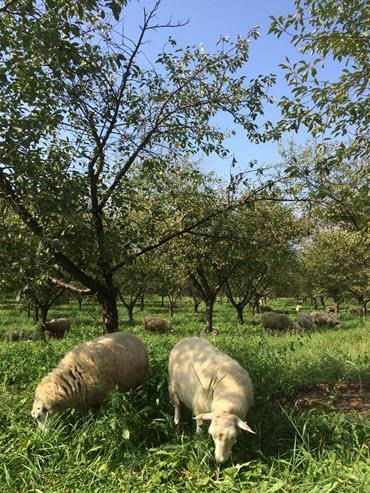
“Woolley’s Lamb is a part of a larger farm operation, which is Schuyler Farms Ltd., and we’re a mixed farm operation growing corn, soybeans, apples, and sour cherries, and now the lambs,” she explained. “Eight years ago, we got the idea to integrate the sheep into the orchard and that’s where it all started and has really grown from there.”
Woolley and her husband now raise the lambs using orchard grazing and silvopasture, which both involve raising livestock and trees in a mutually beneficial way.
“We can produce meat and fibre and timber and fruit all on one piece of land,” Woolley said.
She’s excited for the future of small- and medium- sized creative agricultural enterprises, she explained.
“There are some amazing operations out there,” she said. “What excites me is the collaboration and integrating the livestock in with the orchards and the cash crops, and just trying to do things differently and better … There’s so much opportunity out there, I look at all the crop residues from the horticulture industry and the cash crop industry and there’s huge potential.”
Being recognized alongside innovative businesses from around the world was a humbling experience, she added.
“The ideas that those other businesses have come up with, and the situations that some of those businesses are dealing with – I was blown away,” Woolley said.
For example, ColdHubs is a business from Nigeria that builds solar powered walk-in cold rooms to store produce and prevent spoilage. The United Nations Food Systems Summit helps to showcase what innovative solutions are possible, even in extremely difficult conditions.
“Those are the people that are going to change communities. It was pretty neat,” Woolley said. “We definitely need to help small and medium sized businesses grow and support them, because they give back to communities, and I think that’s going to be really critical here going forward for the planet.”
Woolley’s Lamb hopes to continue to expand and improve, she explained. They are aiming for more productivity in the silvopastures with a focus on nature and native biodiversity, and potentially incorporating other livestock like geese and pigs.
“It’s taken us a long time to grow it’s business and we’re getting close to that stage where we’re going to be happy… there’s lots of stuff that we’re playing around with. There’s always more,” Woolley said.
Woolley photo