Canada Pork International will receive $6M to grow national pork exports
By Diego Flammini
Staff Writer
Farms.com
The federal government is investing in market diversification for Canadian pork.
Today, Agriculture and Agri-Food Minister Marie-Claude Bibeau announced $6 million in funding to Canada Pork International (CPI) through the Canadian Agricultural Partnership’s AgriMarketing Program.
“This funding will support promotion of our world-class pork in Asia, Europe and here in North America through activities that include market research, tradeshow exhibits, targeting high-value markets and growing markets for chilled pork,” Minister Bibeau said during the announcement at Ontario Pork in Guelph, Ont.
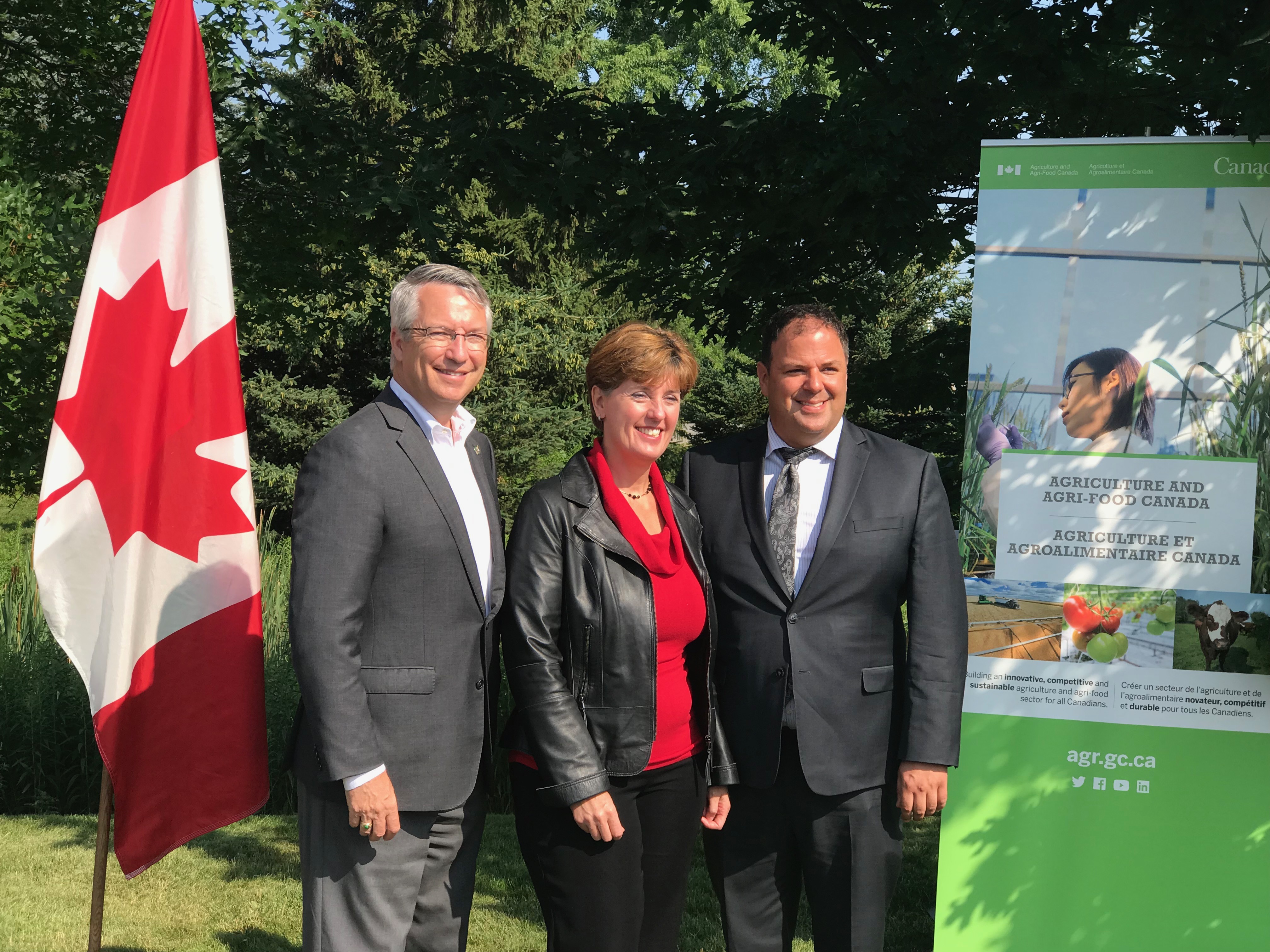
Left to Right: Lloyd Longfield, MP for Guelph, Agriculture and Agri-Food Minister Marie-Claude Bibeau and Martin Lavoie, president and CEO of Canada Pork International.
Canada’s pork sector exported almost $4-billion worth of pork to 89 countries in 2018.
And the country’s involvement in trade agreements like CETA, CPTPP and USMCA provides exporters with access to about 60 per cent of the global economy.
Securing pork trade agreements with other countries is important, especially when China, one of Canada’s largest customers for pork, is refusing imports.
“I’ve been in this industry for 20 years and I’ve seen big markets disappear,” Martin Lavoie, president and CEO of CPI, said during the funding announcement. “We had the Russian market (and) were able to bounce back in the Chinese market” after Russia closed its borders to Canadian pork.
Russia banned pork imports from Canada in 2014 for one year because Canada placed sanctions on Russia for its actions in Ukraine. Since then, Russia has extended the embargo each year.
About 95 million kilograms (209 million pounds) of Canadian pork entered Russia in 2014 but none has gone there since.
Finding new markets will help Canadian pork producers succeed, Lavoie said.
“We’re going to go where the business is,” he said. “But it’s really important to have doors open.”
Pork producers are pleased with the government’s support.
“Today’s announcement reinforces the government’s emphasis on the pork industry,” Eric Schwindt, chair of Ontario Pork, told Farms.com. “The Barton report showed Canadian pork has the potential to grow and drive the economy, and these marketing initiatives will help us take advantage of that potential.”
Minister Bibeau also addressed the trade landscape with China.
The two countries continue to talk, she said.
“We have shared with them some additional measures to strengthen the system to reassure them and hopefully have the markets reopening as soon as possible,” she told reporters. “Having these regular conversations still makes me hopeful that we will have the (Chinese) market for pork and beef open as soon as possible.”