Farms.com Home   Ag Industry News

Salford happy to be talking Javelin spreaders in Louisville

Farm Show Snapshot

By Farms.com Media Team

Marketing manager Anson Boak was pleased with the response to the new options available for its Javelin spreader at the National Farm Machinery Show in Louisville last week.

Left and right side control will allow operators to follow a precision ag map, which will cut back on a lot of wasted application, according to Boak.

“And this week is the first time we’ve talked about these new options for specific models.”
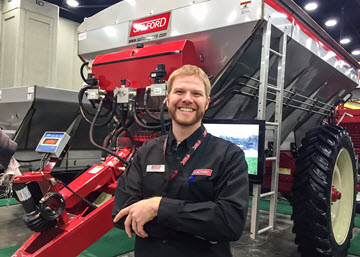
Salford acquired BBI in October 2014, and the BBI Javelin is the largest single-axle, dry material, top dress applicator on the market. It’s the first precision fertilizer applicator to achieve a true spread pattern and drive interval of 120 feet. It also features a 282 cu. ft. hopper.

Anson, pictured in front of the Javelin at the NFMS, was pleased with the event.

“It has been a good show for us. Famers are seeing lots of new products.

“If attendance is down a bit, that is definitely being offset by the quality of customers we are talking to.”

Boak is based in Salford, Ontario. He said that farmers at the show were “engaging and also buying.

“There is no doom and gloom, from what I’ve heard. Up to and following the drought in 2012 we had some very big years in our industry. Now it’s something of a return to normal.

“Farmers are paying very close attention to cash flow, and watching their costs per acre.”


Trending Video

Evolution of Beef Cattle Farming

Video: Evolution of Beef Cattle Farming

The Clear Conversations podcast took to the road for a special episode recorded in Nashville during CattleCon, bringing listeners straight into the heart of the cattle industry. Host Tracy Sellers welcomed rancher Steve Wooten of Beatty Canyon Ranch in Colorado for a wide-ranging discussion that blended family history and sustainability, particularly as it relates to the future of beef production.

Sustainability emerged as a central theme of the conversation, a word that Wooten acknowledges can mean very different things depending on who you ask. For him, sustainability starts with the soil. Healthy soil produces healthy grass, which supports efficient cattle capable of producing year after year with minimal external inputs. It’s an approach that equally considers vegetation, animal efficiency, and long-term profitability.

That philosophy aligned naturally with Wooten’s involvement in the U.S. Roundtable for Sustainable Beef, where he served as a representative for the Colorado Cattlemen’s Association. The roundtable brings together the entire beef supply chain—from producers to retailers—along with universities, NGOs, and allied industries. Its goal is not regulation, Wooten emphasized, but collaboration, shared learning, and continuous improvement.