If you live in an area where the 990 was popular, you could score a great deal on reliable farm power
IN THE SHOP with Rachel
By Rachel Gingell
Farms.com
At its height, the David Brown Company was one of the largest tractor manufacturers in the United Kingdom. After World War II came to a close, David Brown exploded with innovation and rapid manufacturing. Its tractors were at the cutting edge of technology and featured sturdy designs. They were sold all over the world, including in Canada and the United States. At one time, more than 80 per cent of the tractors David Brown produced in England were sent abroad for sale.
The 990 is no exception to the standard of reliability. The tractor was first sold with the “Implematic” designation (sometimes also called a 990a). These tractors featured the classic red and yellow paint scheme and a manual transmission. The 990 Implematic was manufactured from 1961 until 1965.
In 1966, the tractor was upgraded to a Selectamatic transmission. The model designation changed to a 990 Selectomatic (also referred to as a 990b). These tractors were produced from 1966 until 1980 – an impressive production run of more than 67,000 tractors!
The tractor was a sturdy design, with an efficient 195 cubic inch diesel engine. The 990 is in the 50-hp class and came with an optional four wheel drive. It’s a fantastic little powerhouse.
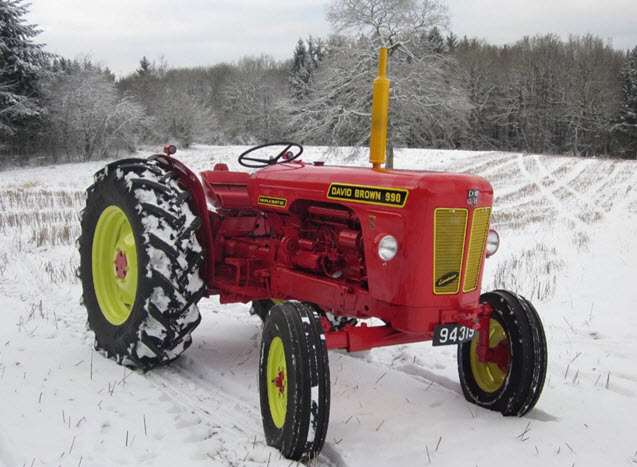
1965 David Brown 990 Implematic.
Photo: Nico Roeder/TractorData.com
David Brown was purchased in 1976 by the same parent company that owned J. I. Case. The best tractors of each brand were retained in the merger, and the 990 Selectamatic was a clear keeper. The paint scheme was updated, and the tractor was produced with two different sets of decals depending on the market – either a Case 990 or a David Brown 990 Selectamatic. Other than the stickers on the hood, these two models are identical.
If you’re interested in purchasing a David Brown 990 Selectomatic or the sister model Case 990, here are two things to watch for.
First, inspect the hydraulics carefully. As the tractors age, the hydraulic system is often the first thing to show wear – especially if it’s seen heavy use as a loader tractor. The hydraulic system can be a complicated fix.
It’s best to avoid trouble and buy a model that doesn’t show signs of heavy use.
Secondly, consider the spread of David Brown tractors in your area. Some parts of North American had plenty of David Brown tractors, making salvage parts and skilled mechanics easy to find. In other regions, these tractors were rare birds. Because the tractors were manufactured abroad, domestic aftermarket parts retailers have been slow to pick up the product line. Before you buy, be confident that parts are available in your region.